

deer tick
 1
6.0
1
6.0

- noun
- /dɪr tɪk/
- Specialized
- To protect yourself from Lyme disease, be wary of deer ticks when walking in wooded areas.
- deer tick virus
- deer tick virus encephalitis
Loading YouTube…
Watch on YouTubeBut it turned out she got bit by a tick and a tick, a deer tick that had Lyme disease.
- But it turned out she got bit by a tick and a tick, a deer tick that had Lyme disease.
- The first to discover the deer ticks carry Lyme disease.
Examples
-
Two months ago, I was bitten by a second deer tick, so I have been doing the cleanse as a precaution.
Blog text (18) -
Deer ticks can produce up to 3,000 eggs before dying.
Blog text (25) -
The first to discover the deer ticks carry Lyme disease.
-
The blacklegged deer tick is endemic to this region.
Blog text (25) -
The deer tick, Ixodes scapularis, carries Borrelia burgdorferi, the bacteria that cause Lyme disease.
Academic text (2008) -
She checked her clothes thoroughly for deer ticks after hiking in the tall grass.
-
The doctor explained that deer ticks can transmit Lyme disease if they attach to the skin for too long.
Synonyms
 50
6.7
50
6.7
A small animal that sticks to the skin and sucks blood from animals or people

A small black tick that bites animals and people and can spread Lyme disease
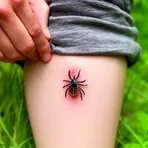
A small tick found in eastern North America that bites people and can give them Lyme disease
Surface Forms
Morphology
The compound 'deer tick' is transparently built from 'deer' (a hoofed mammal) + 'tick' (a small blood-feeding arachnid), so its basic meaning — a tick associated with or found on deer — can be directly inferred. This is a regular noun–noun compound found cross-linguistically, so a B1 learner who knows both constituents will understand the general referent even if they do not know specific epidemiological details.
Etymology
Deer tick is named for the small animal, a tick, that often lives on deer and feeds on their blood. That is why the name refers to the tick that can bite people and is a 'carrier of Lyme disease'.