
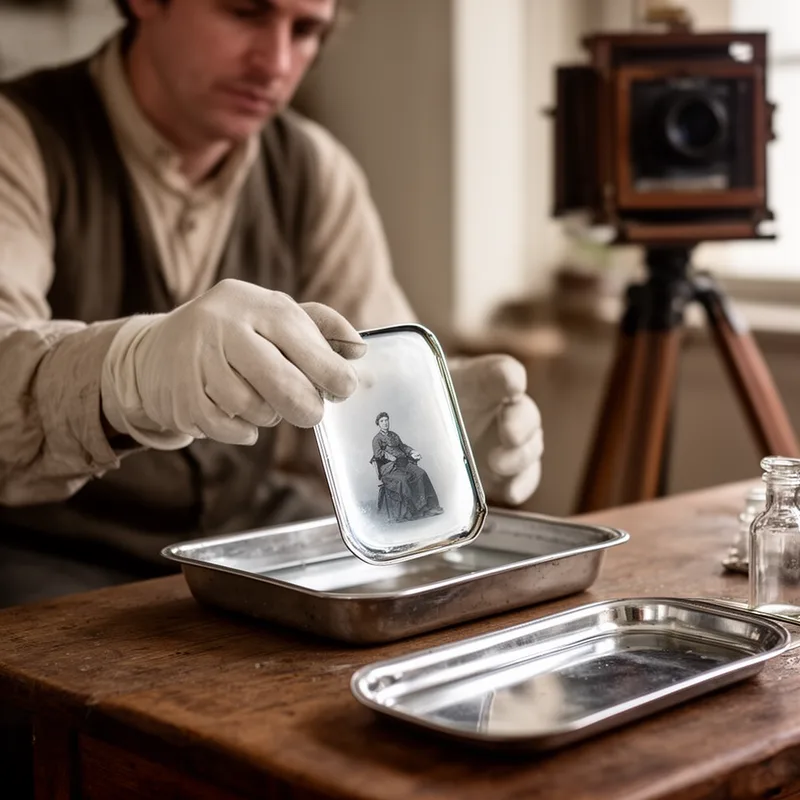
daguerreotypy
- noun
- /dəˈɡɛrəˌtɑpi/
- Archaic
- Reading for the last time Robert Schlaer's article on "Modern Daguerreotypy" (Volume 2, Numbers 1 and 2 Photographic Canadiana), which gives tips on suitable subjects, I headed out to make an exposure.
Examples
-
After leaving his jewelry business in 1841, he apparently tried his hand at daguerreotypy with Echols.
Academic text (2008) -
The artist used daguerreotypy to capture stunning images of the landscape during his travels in the 19th century.
-
Much of Georgia was still unsettled when Samuel F. B. Morse published his description of daguerreotypy in May 1839, along with Alexander S. Wolcott and John Johnson of New York.
Academic text (2008) -
Henry Hunt Snelling published his History and Practice of the Art of Photography in 1849, and in 1850 a more formalized choice for photographic education became available when Levi L. Hill opened a school of daguerreotypy in the state of New York.
Academic text (2008) -
At the museum, visitors can view examples of daguerreotypy that showcase the intricate details of early photography.
-
Learning daguerreotypy requires a deep understanding of the chemical processes involved in developing photographs.
Synonyms

 249
2.8
249
2.8

Making pictures with a camera as art or a job

An early way of making photographs on paper coated with chemicals that react to light
How Complex


Surface Forms
Morphology
daguerreotypy = daguerreotype (semi-transparent) = daguerreotype + y
Built from 'daguerreotype' with '-y' to denote the practice/process; formation is clear from the base but the suffixal nuance is technical and uncommon.
Etymology
Daguerreotypy comes from the name Daguerre and the part -type, meaning 'image' or 'impression'. So daguerreotypy can also mean the art or process of making pictures by Daguerre's method, explaining why the word refers to how those early photos were made.