

cytokinesis
- noun
- /ˌsaɪtəʊkɪˈniːsɪs/
- Specialized
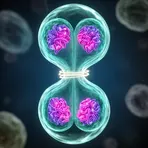
- The process of cytokinesis occurs during the last stages of mitosis, where the cell divides into two.
Examples
-
Completion of mitosis via cytokinesis results in two daughter cells.
Academic text (2003) -
In angiosperms, the female gametophyte develops from a functional megaspore via three or more rounds of mitosis without cytokinesis.
Academic text (2018) -
In early Drosophila embryos, nuclei undergo rapid, synchronous divisions without being separated into individual cells by cytokinesis.
Blog text (5) -
One such syndrome, dedicator of cytokinesis 8 protein (DOCK8) deficiency, has revealed key players and also highlighted limitations to the studies of human diseases.
Academic text (2016) -
Following nuclear division, the microbody divides completely to form two daughter microbodies, and cytokinesis occurs (Figure 3aV, aVI).
Academic text (1996) -
From knowledge of the frequency of dividing zooxanthellae cells in the host and the duration of cytokinesis, t d (approximately 11 hours for zooxanthellae), the exponential growth rate of the population can be calculated as
Academic text (1993) -
Completion of mitosis via cytokinesis results in two daughter cells.
-
During cell division, cytokinesis is the final step that separates the cytoplasm into two distinct daughter cells.
Synonyms


 1
3.8
1
3.8
A process in which a cell splits to make two or more new cells for growth and reproduction
Surface Forms
Morphology
Etymology
Cytokinesis is made of cyto- meaning 'cell' and -kinesis meaning 'movement', so it literally means 'cell movement' and describes the movement that splits one cell into two daughter cells.