

curvilinear correlation
- noun
- /ˌkɜrvəˈlɪniər kəˈrɛleɪʃən/
- Specialized
- Unlike a linear trend, a curvilinear correlation may rise to a peak and then fall.
Examples
-
A curvilinear correlation is observed when plotting age against happiness in some studies.
-
The study revealed a significant curvilinear correlation between stress and performance.
-
Researchers noted a curvilinear correlation between income and life satisfaction.
-
Researchers found that a curvilinear correlation often indicates complex relationships.
-
The study revealed a significant curvilinear correlation between stress and performance.
-
Researchers found that a curvilinear correlation often indicates complex relationships.
-
A curvilinear correlation is observed when plotting age against happiness in some studies.
Synonyms
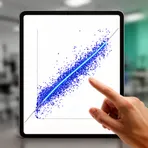
A link between two things where change is not steady and dots do not form a straight line

A relationship between two things where one changes at different speeds
How Curved
- Specialized
 8
5.4
8
5.4


- Specialized

 1
8.1
1
8.1
- Specialized
- Specialized
Surface Forms
Morphology
This is a straightforward adjective+noun composition: a B1 learner who knows 'curvilinear' (following curves) and 'correlation' (a relationship between variables) can infer a correlation that forms a curve rather than a straight line. The meaning is directly compositional and follows common cross-linguistic patterns for descriptive modifiers, so it should be immediately understandable.
Etymology
Curvilinear correlation comes from the picture of a graph: curvilinear means a curving line and correlation means a 'relationship'. So the term describes a 'relationship' between two things that makes a curve on a graph, for example rising and then falling, not a straight line.