

Curie
 3
5.8
3
5.8

- proper noun
- /ˈkjʊəri/
- Many students learn about Marie Curie's achievements in science, particularly her famous work with radioactive elements.
- Marie Curie
Loading YouTube…
Watch on YouTubeOK, what did Marie Curie do during the First World War?
- OK, what did Marie Curie do during the First World War?
- You know, if you could be with Newton or Gauss or Madame Curie or Einstein, you know, you would respect them.
- And Marie Curie, although she's the only female scientist that many people can name, she's not the only one.
- Even the second Nobel Prize didn't extinguish Marie Curie's passion, Albert Einstein said of his close friend Marie Curie.
- Not Einstein's brain, not Marie Curie's brain, but the one in your head.
- I have, like, you know, you have Aristotle, you have Plato, you have Marie Curie, you have you have Confucius, you have.
- I, I got the So he, he works on Pride and Prejudice, he works on Madame Curie, Jane Eyre, A Woman's Vengeance, Prelude to Fame.
Examples
-
- I'm looking for Marie Curie.
-
Only 24 of the 600 awards were given to women: Marie Curie won two of them, and her daughter won a third.
Academic text (1995) -
OK, what did Marie Curie do during the First World War?
-
- Did you know Madam Curie, too?
-
"Today I was reading about Marie Curie."
-
The upper picture is Marie Curie again, sitting lonely in a sea of grey men.
-
In Paris, Marie met the physicist Pierre Curie, who shared his lab and his heart with her.
-
Most undergraduates, in my experience, can name no famous female scientist other than Marie Curie.
Academic text (1998) -
Today she's dressed as Marie Curie, the scientist who discovered radium.
-
Even the second Nobel Prize didn't extinguish Marie Curie's passion, Albert Einstein said of his close friend Marie Curie.
Synonyms

Polish-born French chemist and physicist who won two Nobel Prizes for work on radioactivity and discovering radium and polonium
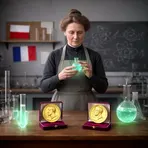
A scientist born in Poland who worked in France and won two Nobel Prizes for discovering radium and polonium

The birth name of Marie Curie, a Polish scientist who studied radioactivity
Compounds

- Specialized
Temperature at which a magnetic material loses its strong, permanent magnetism when heated

- Specialized
The temperature above which a magnetic material loses its strong magnetism and becomes weakly magnetic
Surface Forms
Etymology
Curie is a French family name that Marie Curie used after she married; she was a Polish-born scientist who discovered radium and polonium and won two Nobel Prizes. That's why Curie now brings to mind her name and those important discoveries.