
Curie point
- noun
- /ˈkjʊəri pɔɪnt/
- Specialized
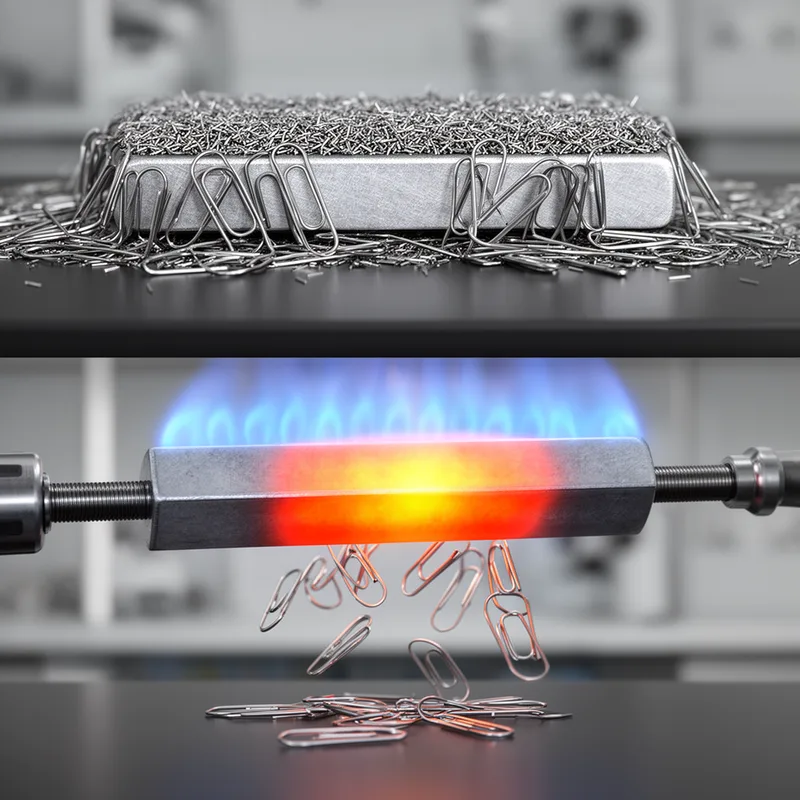
- The temperature at which iron reaches its Curie point is approximately 770 degrees Celsius, where it loses its ferromagnetic properties.
Examples
-
In this process, the energy within the focused optical spot heats the recording material past its Curie point (about 200 degrees C), a threshold above which the magnetic domains of the material are susceptible to moderate (about 300 gauss) external magnetic fields.
Academic text (1996) -
When the material is cooled below the Curie point, this orientation of the magnetic domains is fixed.
Academic text (1996) -
The magnetization is zero above and finite, nonzero below the critical point, called a Curie point in this context.
Academic text (2002) -
When a ferromagnetic material like nickel is heated beyond its Curie point, it becomes paramagnetic and loses its magnetic ordering.
-
In practical applications, knowing the Curie point is crucial for understanding how magnetic materials behave at varying temperatures.
Synonyms

The temperature above which a magnetic material loses its strong magnetism and becomes weakly magnetic
Surface Forms
Morphology
This term is not compositionally derivable by a B1 learner: 'Curie' is an eponym (or a technical unit) that does not transparently signal magnetism, and while 'point' can suggest a specific temperature or stage, it does not on its own indicate loss of ferromagnetism. The specific scientific meaning (temperature where a material becomes paramagnetic) requires prior domain knowledge, so learners who only know the literal constituents would not be able to infer the MWE's meaning.
Etymology
Curie point is named after the scientist Pierre Curie, who discovered that heating some metals makes them suddenly stop being magnetic. So the Curie point is the exact temperature where a material 'loses its magnetism'.

