
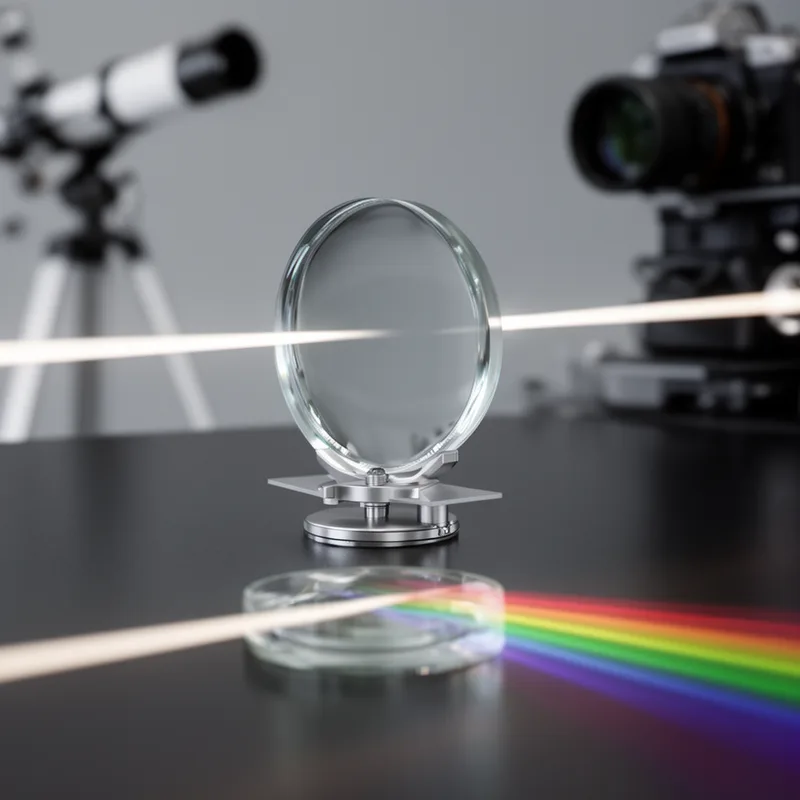
crown glass
- noun
- Specialized
- Optical engineers often choose crown glass for its low refractive index in precision lenses.
Examples
-
The camera lens contains elements made from crown glass to minimize distortion.
-
Early telescope makers relied on crown glass before advanced materials were available.
-
The crown glass provides excellent optical performance.
-
Many photographers prefer crown glass for its clarity.
-
Optical engineers often choose crown glass for its low refractive index in precision lenses.
-
Early telescope makers relied on crown glass before advanced materials were available.
-
The camera lens contains elements made from crown glass to minimize distortion.
Synonyms

Clear glass used in camera lenses that bends light less and keeps colours from separating

A clear glass used in lenses that bends light only a little
How Refractive


Surface Forms
Morphology
The compound 'crown glass' clearly signals a type of glass (crown + glass), so a B1 learner who knows both words would likely infer it refers to a particular kind of glass. However, the specific production method (blown into a globe and spun into a disk) and historical window use are technical/historical details that are not predictable from the constituents alone. Because the basic category is transparent but the specialized sense is not fully derivable, this is best classified as semi-transparent.
Etymology
The noun crown glass comes from old glassmakers who made a clear, round piece in the middle of a spun disk and called that central piece a crown. Those round pieces let light pass with very little color change, so they were used for lenses — that's why crown glass now means a kind of optical glass with low dispersion.