

crested wheat grass
- noun
- Specialized
- The field was reseeded with crested wheat grass after the drought to restore vegetation.
Examples
-
Farmers often rely on crested wheat grass as a reliable forage crop for their livestock.
-
Crested wheat grass is widely planted on the prairies to prevent soil erosion.
-
Farmers often plant crested wheat grass to improve soil health.
-
The crested wheat grass in my field is thriving this season.
-
Farmers in the Great Plains often plant crested wheat grass to improve soil stability and provide grazing for livestock.
-
Because of its drought resistance, crested wheat grass is a popular choice for restoring degraded rangelands.
-
To control erosion effectively, many landowners chose to sow crested wheat grass in affected areas.
Synonyms

A grass from Europe and Asia that farmers grow for animal feed and to stop soil erosion
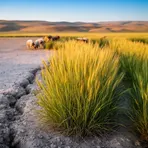
A grass from Europe and Asia grown on dry plains to feed animals and stop soil washing away
Surface Forms
Morphology
The noun phrase is fully compositional: 'crested' (having a crest) + 'wheat' + 'grass' signals a particular kind of grass related to wheat or with wheat-like features, so the general meaning 'a species/kind of grass' is directly derivable from the parts. While the precise botanical name may be unfamiliar, the referent (a type of grass used for forage/soil control) is predictable from the constituents and thus understandable to a learner who knows the individual words.
Etymology
Crested wheat grass gets its name from how the plant looks: the top of each stem has a small 'crest' and the seed heads look like little wheat, so people called it crested wheat grass. That's why the name now refers to a common grass grown for 'food for animals' and to 'prevent erosion'.

