

creeping bugle
- noun
- Specialized
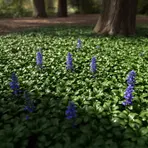
- Many gardeners plant creeping bugle to suppress weeds and prevent soil erosion.
Examples
-
The creeping bugle quickly spread to cover the bare patches in the garden.
-
With its vibrant flowers, creeping bugle adds color to shady lawns every spring.
-
The creeping bugle blooms beautifully in spring.
-
I planted some creeping bugles in my garden.
-
Many gardeners choose creeping bugle as a ground cover because it suppresses weeds effectively.
-
The creeping bugle thrives in shaded areas, providing a lush carpet of blue flowers in spring.
-
To enhance the garden's appearance, I decided to plant creeping bugle along the pathway.
Synonyms


 1
9.6
1
9.6
A low evergreen plant that spreads to cover the ground

A low plant with blue flower spikes used to cover the ground in shady gardens

A low, spreading evergreen plant used to cover the ground in gardens
How Spreading

Surface Forms
Morphology
The phrase is a straightforward adjective+noun compound where 'creeping' (spreading, low-growing) modifies 'bugle' (the mat-forming herb), so the overall meaning—a low-growing bugle plant—is directly derivable from the parts. This compounding pattern is productive and cross-linguistically common, so a B1 learner who knows both constituents would readily understand the MWE.
Etymology
Creeping bugle gets its name from how the plant grows: the word creeping shows it moves along the ground, and bugle refers to the blue flowers that look like a small horn. So the name describes a low plant that spreads to be 'ground cover'.