

to crawl in
 3
3.3
3
3.3

- phrasal verb
- /krɔl ɪn/
- Informal
- If I'm home, I have to fight the urge to crawl in bed.
- crawl in bed
- let him crawl in
Examples
-
I found my way over to the bed and crawled in, kicking off my shoes.
Fiction book (1998) -
He crawled in, and she pulled the covers up to his neck and tucked him in.
Fiction book (1996) -
I remember crawling in just... just before dawn.
-
I crawled in, too, and lay down on my back.
Fiction book (1991) -
Then she threw the cover off her bed, crawled in, and pulled the sheet up under her chin.
Fiction book (1999) -
I'm going to go home early tonight, and I'm going to take a warm shower, and I'm going to crawl in the bed, and get a good night's sleep.
-
When the heaviness of sleep overcame me, she pushed the cover aside and crawled in gently next to me.
Fiction book (1996) -
After a long day, I am ready to crawl in bed and relax.
-
Feeling exhausted, she decided to crawl in bed earlier than usual.
-
He crawled in bed hoping to get some rest before the big day.
Synonyms
 485
1.0
485
1.0
To get into bed to sleep
 27
3.5
27
3.5
To go to bed to sleep
 16
5.8
16
5.8
Go to bed to sleep, usually at night
 10
6.0
10
6.0
To go to bed to sleep
 8
6.0
8
6.0
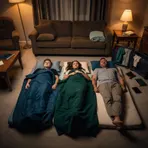
To go to bed to sleep after a long day
 5
6.8
5
6.8
To sleep in a temporary place like on the floor or in the living room
 4
7.5
4
7.5
To go to bed to sleep
 4
4.5
4
4.5
To sleep in a temporary place like a barn or tent
 4
3.7
4
3.7
To go to bed and fall asleep quickly because you are tired
 1
8.6
1
8.6
To go to bed to sleep


 1
8.8
1
8.8
To sleep very early, often soon after sunset

To go to bed or sleep
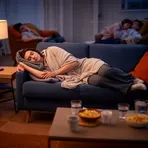
To sleep somewhere for a short time, often on a sofa
How Tired

Surface Forms
Morphology
The verb 'crawl' (move slowly/close to the ground) combined with the directional particle 'in' gives a clear image of entering somewhere slowly, so a learner can infer a sense of 'entering' or 'going inside'. However, the specific conventionalized meaning 'go to bed' (often short for 'crawl into bed') depends on collocational/pragmatic knowledge and is not fully predictable from the parts alone, so it is only partially transparent to a B1 learner.
Etymology
Crawl in paints a simple picture: a very tired person crawls slowly and moves in under the bed covers to rest. So, crawl in means 'to go to bed', usually slowly because you are very tired.