
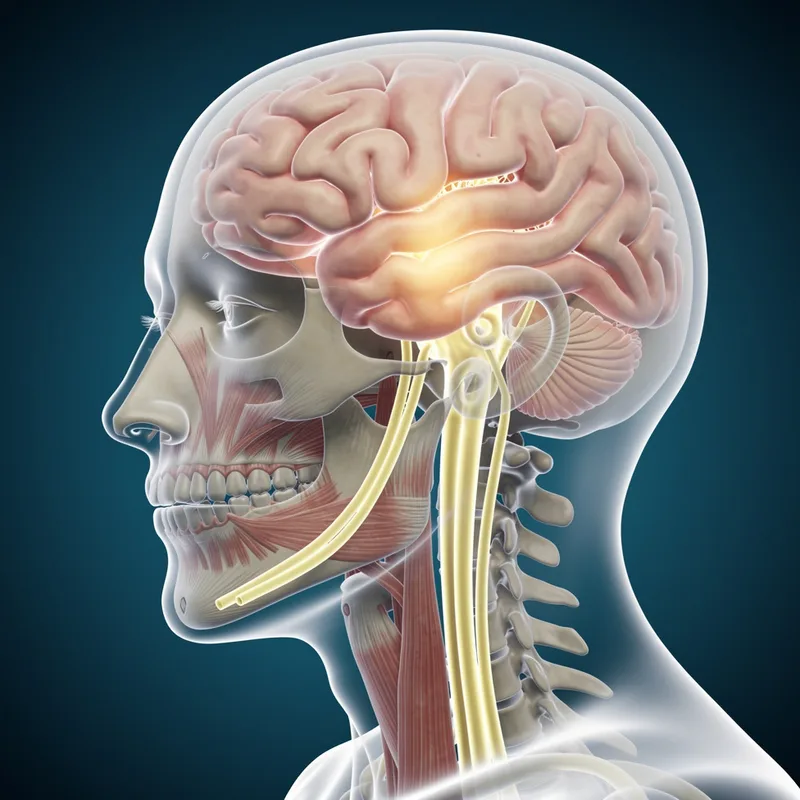
cranial nerve
 2
4.9
2
4.9

- noun
- /ˈkreɪniəl nɜrv/
- Specialized
- Damage to the cranial nerves can lead to symptoms such as facial weakness or loss of smell.
- cranial nerve palsy
- cranial nerve deficit
- cranial nerve examination
Examples
-
The most common site of head and neck schwannomas is the VIII cranial nerve.
Academic text (2009) -
The most common morbidity associated with jugular fossa lesions is lower cranial nerve deficits.
Academic text (2009) -
The most common presenting complaint is diplopia, which is caused by cranial nerve compression.
Academic text (2008) -
Nearly 40% of patients with follow-up data had cranial nerve palsies.
Academic text (2013) -
Patients can present with hearing loss and lower cranial nerve deficits if tumors are of sufficient size.
Academic text (2008) -
There were no palpable intraparotid masses, and all cranial nerves were intact.
Academic text (1999) -
Findings at presentation vary; they may include cranial nerve deficits, headache, visual changes, and even seizures.
Academic text (2006) -
Even when small, these firm tumors can compress cranial nerves VII and VIII and produce symptoms.
Academic text (2010) -
Physical examination revealed left-sided proptosis with periorbital edema, erythema, and a left-sided cranial nerve VI palsy.
Academic text (2009) -
The doctor explained how each of the twelve cranial nerves controls different functions in the head and neck.
Surface Forms
Morphology
The meaning is directly and transparently built from 'cranial' (associated with the skull/brain) + 'nerve' (a bundle of nerve fibers), so a learner who knows both words can infer it refers to a nerve related to the skull/brain. Although the term is technical, its adjective+noun composition is regular and cross-linguistically common, making the sense predictable for B1 learners who know the constituents.
Etymology
Cranial nerve comes from words about the skull: cranial means 'of the head' and nerve is a cord that 'carries signals'. These are the nerves that come straight from the brain to the head and neck, so the term means those head and neck nerves today.