

cow parsnip


 1
8.8
1
8.8
- noun
- /kaʊ ˈpɑːr.snɪp/
- US
- In the summer, the trail was lined with towering cow parsnips, their white flowers reaching for the sky.
Examples
-
He pauses to eat a cow parsnip leaf, which flaps like the wings of a frightened bird as it goes into his mouth.
Fiction book (1990) -
As I reach this place on the trail, my eye rises above a feathery late-summer tangle of wild raspberry, cow parsnip, and mountain hollyhock.
Fiction book (1990) -
Plant growth appeared almost tropical, with ten-foot-high cow parsnips, ostrich ferns too dense to walk through, and a forest floor covered with jack-in-the-pulpit, Dutchman's-breeches, and lily of the valley.
Academic text (1995) -
The dense forest was filled with cow parsnip plants, which grew taller than the people walking through it.
-
During our hike, we spotted several cow parsnips blooming along the riverbank, adding beauty to the landscape.
Synonyms
 1
9.3
1
9.3
A tall plant with thick stems and groups of white or purple flowers that can irritate the skin
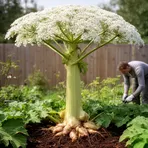
A large plant with thick roots and big white flower clusters
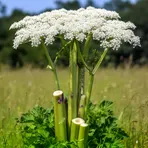
A tall wild plant with thick stems and large white flower clusters
Surface Forms
Morphology
cow + parsnip
The compound is directly compositional: a learner who knows 'cow' and 'parsnip' can infer it refers to a kind of parsnip-like plant (likely large or associated with cows). Although the botanical species is not the same as the garden parsnip, the naming pattern is transparent and cross-linguistically common, so a B1 learner can derive the basic meaning from the parts.
Etymology
Cow parsnip may get its name from a simple picture: people saw a very large wild plant that looked a bit like a parsnip, and cows would often eat or stand near it. So the name joins cow and parsnip and helps you remember a big plant with thick stems and groups of white or purple flowers.