
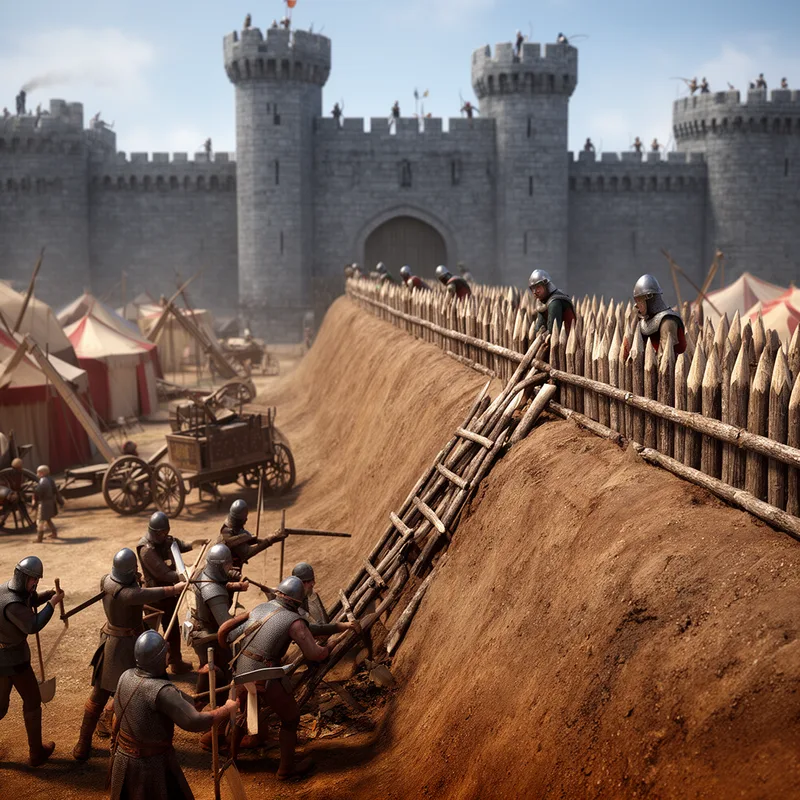
contravallation
- noun
- /ˌkɒntrəˌvæleɪˈʃən/
- Archaic
- The army constructed a contravallation to protect themselves from sorties by the city's defenders.
Examples
-
Historical accounts detail the contravallation surrounding the fortress during the lengthy siege.
-
Engineers were tasked with repairing the damaged contravallation after the defenders' night raid.
-
The army built a contravallation to secure their position.
-
During the siege, the contravallation served as a vital defense.
-
The engineers reinforced the contravallation to safeguard against any surprise attacks from the defenders.
-
Historical documents describe the extensive contravallation that protected the besieging forces from counterattacks.
-
To ensure their safety, the army erected a strong contravallation around the city to fend off the defenders' sorties.
Synonyms

 12
6.6

A wall or earth mound built to protect a place from attack

 1
9.9
A defensive position where soldiers stand behind trenches during war
 1
9.9
A low wall or bank of earth built to protect a camp
Surface Forms
Morphology
contravallation = contravallate (opaque) = contra + vall + ation
The verb 'contravallate' and the root 'vall-' (from Latin for rampart) are specialized/archaic, so most learners cannot derive the meaning from the base.
Etymology
The word contravallation breaks into contra- meaning 'against' and vallation from a Latin word for 'wall', like the English wall. So a contravallation is a 'wall against' the defenders — a line of defensive walls attackers build around a place during a siege to protect themselves.