

continuo
- noun
- /kənˈtɪnjuˌoʊ/
- Specialized
- Yet in Huygens's time, such inscribed numbers were still rare; for a choice of chords on the given bass, the continuo player generally had to rely on his ears and his familiarity with the style.
- basso continuo
Examples
-
During the performance, the cellist skillfully blended her playing with the continuo provided by the keyboard.
-
The notation is rather exceptionally confined to the basso continuo, which was performed on either a theorbo (a bass lute) or a keyboard instrument.
Academic text (1991) -
Ensuring the continuos performance of the essential functions of our Government during a time of war.
-
The orchestration is mostly just for strings and continuo, though three numbers have various woodwinds in them.
Academic text (2000) -
We study the arcana of the Baroque basso continuo, for example, simply because sounds are basic.
Academic text (1992) -
Beautiful, beautiful solo violin writing there with Basso continuo underneath, solo concertos for violin and harpsichord.
-
Note: Excerpt of Five Canzonets. 'The Prune Song' by Jean Berger. Copyright 1965 by Tetra/Continuo Music Group. Originally published by Alexander Broude.
Academic text (1998) -
For example, the harpsichordist in baroque music must follow figured bass symbols plus the sounds of the soloist as a structural basis for creating and performing (improvising) the continuo part.
Academic text (1991) -
In Baroque music, the harpsichord provides the continuo that plays the chords beneath the solo instruments.
-
The composer wrote a piece that requires a continuo part to support the vocal melodies.
Synonyms
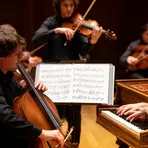
A low part in Baroque music that supports the harmony and is played throughout by instruments like cello and harpsichord

A bass line written with numbers that show the chords to play

A bass part with numbers that show which chords a keyboard player should play
Compounds
- Specialized
A low part in Baroque music that supports the harmony and is played throughout by instruments like cello and harpsichord
Surface Forms
Etymology
The word continuo comes from Italian and from the Latin verb continuare, which means 'to continue' or 'not stop', like the English word 'continue'. In Baroque music the continuo is the steady bass that keeps playing under the other parts, often with numbers showing which chords to play, so the name fits.

