
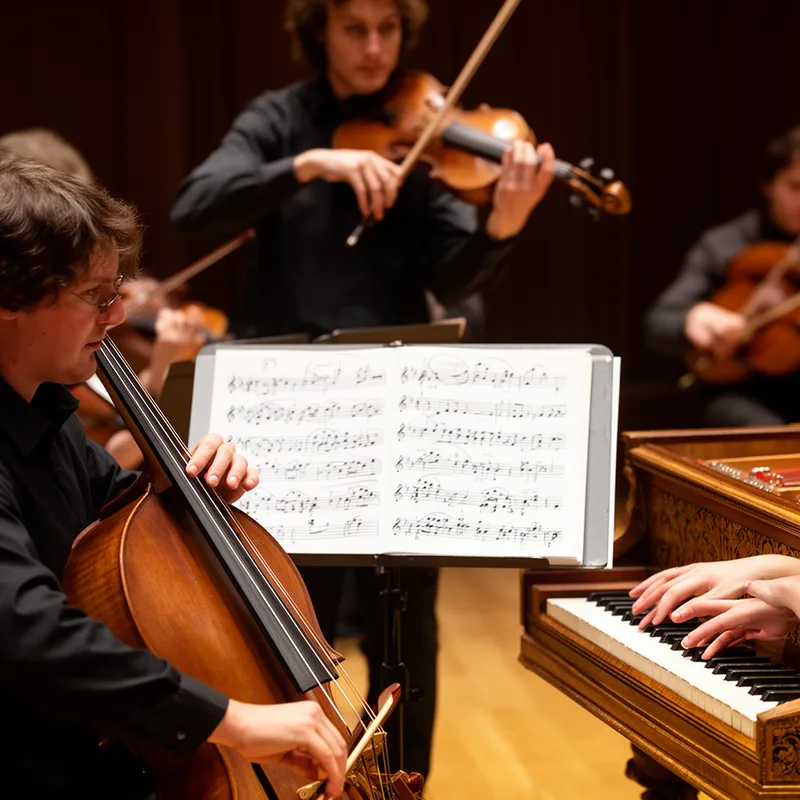
basso continuo
- noun
- /ˈbæs.oʊ kənˈtɪ.nu.oʊ/
- Specialized
- Musicians often refer to the basso continuo as the backbone of Baroque ensembles.
Examples
-
The basso continuo provides a harmonic foundation for many Baroque compositions.
-
In Baroque music, the basso continuo is essential for creating rich harmonies.
-
What is more central to Baroque music than the sound of the basso continuo?
Academic text (1992) -
We study the arcana of the Baroque basso continuo, for example, simply because sounds are basic.
Academic text (1992) -
Beautiful, beautiful solo violin writing there with Basso continuo underneath, solo concertos for violin and harpsichord.
-
The notation is rather exceptionally confined to the basso continuo, which was performed on either a theorbo (a bass lute) or a keyboard instrument.
Academic text (1991)
Synonyms

A continuous low bass part played on a keyboard alongside a bass instrument with numbers that show the chords

A bass part with numbers that show which chords a keyboard player should play

A bass line written with numbers that show the chords to play
Surface Forms
Morphology
basso + continuo
Basso continuo is literally Italian for ‘continuous bass’ (basso = bass/low, continuo = continuous bass line), so the definition 'a continuous bass part in Baroque music' is directly derivable from the constituents. Although it is a technical, borrowed musical term and may be unfamiliar to general learners, a B1 learner who knows the meanings of the parts can understand the MWE compositionally.
Etymology
Basso continuo comes from the Italian words basso ('low sound') and continuo ('continuous'), and it names a steady low line used in older classical music. Players such as a cello and a keyboard would play that low line the whole time, with numbers written to show the chords, so it keeps the harmony. That's why basso continuo means 'a continuous bass part that supports the melody and harmony'.

