
continental divide
 1
7.4
1
7.4

- noun
- /ˌkɒntɪˈnɛntl dɪˈvaɪd/
- Specialized
- The bus tour will travel through the Madison River Valley, past the geyser basins, over the continental divide, past Yellowstone Lake, through Hayden Valley to Canyon Junction, and finally on to Mammoth.
- crossing the continental divide
Loading YouTube…
Watch on YouTubeWe are on opposite sides of the Continental Divide and we prefer the eastern side.
- We are on opposite sides of the Continental Divide and we prefer the eastern side.
Examples
-
The aspen would already be showing gold on the higher slopes, and any morning now I would stumble out toward the bus stop and see a powdering of snow along the continental divide.
Fiction book (1995) -
If mass quantities of fresh surface water are departing as cloud masses and raining out to the south of the continental divide in Alaska, that rain will make its way to the Pacific instead of back into the Arctic.
Blog text (6) -
The second gets the south, the third the west coast, and everything else west of the continental divide.
Blog text (10) -
We are on opposite sides of the Continental Divide and we prefer the eastern side.
-
The Rockies stretched north and south, the continental divide to the west.
Fiction book (1999) -
So then, it seems to me that since in the US the continental divide runs north and south, cold arctic air can and does flow towards the Gulf of Mexico.
Blog text (14) -
The hiking trail runs along the continental divide, offering stunning views of both the eastern and western river systems.
-
Crossing the continental divide is a significant moment for hikers as they witness the natural boundary between two major watersheds.
-
The continental divide in North America extends from the Arctic Ocean to the Gulf of Mexico, influencing the flow of rivers across the continent.
Synonyms
 16
7.6
16
7.6
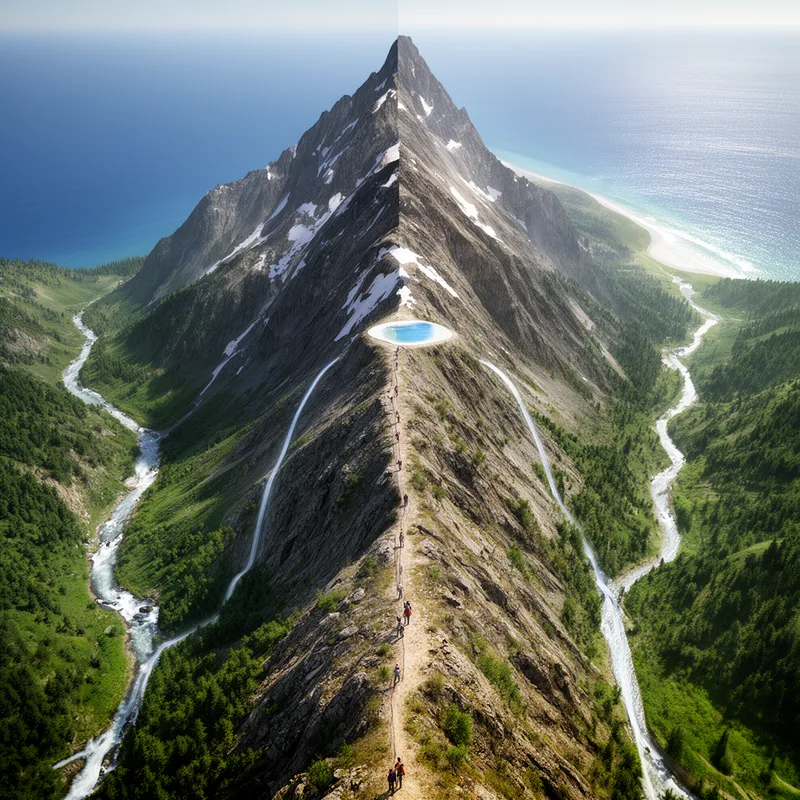
A high line of land that makes rivers flow to different seas
How Big
- Specialized
1
7.4

- Specialized
16
6.1
- Specialized
16
7.6
- Specialized
4
6.0
Surface Forms
Morphology
The meaning is directly built from 'continental' (of a continent) + 'divide' (a ridge or line separating river systems); a learner who knows both constituents can infer it denotes the high-line/watershed that separates rivers on a continent. Although it is a technical geographic term, the composition follows transparent, cross-linguistic patterns and is therefore immediately comprehensible to B1 learners who know the words.
Etymology
Continental divide is the name for a high ridge where rain and streams split: water on one side 'flows' toward one ocean and water on the other side 'flows' toward another. The word continental points to the continent and divide shows the place that 'divides' the groups of rivers, so the name tells you it separates a continent's rivers.