

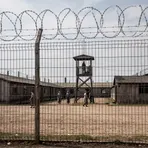
concentration camp
 49
5.6
49
5.6

- noun
- /ˌkɒnsənˈtreɪʃən kæmp/
- Offensive
- Victor Frankl saw a similar phenomenon in Nazi concentration camps during World War II.
- Nazi concentration camps
- German concentration camps
- concentration camp survivor
Loading YouTube…
Watch on YouTubeHis father had been sent to a concentration camp by Stalin.
- His father had been sent to a concentration camp by Stalin.
- He is deporting people to a concentration camp in El Salvador.
- She votes to send people to concentration camps because they do not look like her.
- They've got people in concentration camps in in Xinjiang.
- There's Google imagery of this concentration camp with blood all over the cement.
- My mother was in my Donna concentration camp, which was apparently for women.
- Maidonic and Auschwitz were concentration camps and death camps.
- If people are listening right now, Germans tour concentration camps.
- So this paved the way for the construction of concentration camps.
- Anyone who goes on TV and when asked about what about concentration camps says we have prisons, what's the difference?
- Her, her sister and her parents got put on a train to Auschwitz, the concentration camp.
- My father and my mother, actually both of them came to Belgium by chance after each of them being four and five years in concentration camps in Poland.
Examples
-
The historical documentary detailed the suffering endured by those who survived the concentration camps during the Holocaust.
-
Upon their arrival at the concentration camps, Jews were stripped of the clothing of their former lives.
-
The trip from my house to the concentration camp takes less than 15 minutes.
Fiction book (2000) -
Spent seven years in a Nazi concentration camp.
-
His father had been sent to a concentration camp by Stalin.
-
For the most part, those who remained were slaughtered in concentration camps.
Academic text (2008) -
My father and my mother, actually both of them came to Belgium by chance after each of them being four and five years in concentration camps in Poland.
-
Mr. President, there was a degree of suffering and loneliness in the concentration camps that defies imagination.
Academic text (1998) -
During World War II, many innocent people were imprisoned in concentration camps, where they faced harsh living conditions.
-
Survivors of the concentration camps shared their stories of resilience and hope after enduring unimaginable hardships.
Synonyms
 26
5.3
26
5.3
A camp where guards keep people against their will, often during war
 19
7.5
19
7.5
A prison where people are forced to work, often for political reasons
 10
7.6
10
7.6
A place where people are held under guard during war or for political reasons
 6
7.0
6
7.0
A camp where prisoners must do hard physical work
Antonyms



Surface Forms
Morphology
A B1 learner who knows 'concentration' (high density) and 'camp' (place where people stay) can plausibly infer a literal meaning of a camp where people are gathered or crowded. However, the established sense — forced detention, systematic oppression and the strong historical/Holocaust connotations — is not fully predictable from the constituents, so full understanding requires prior exposure.
Etymology
Concentration camp comes from the idea of 'concentrating' people into one place. The name was used in the early 1900s for camps where civilians were gathered and kept in crowded, very harsh conditions during war, so today it means a place where many people are imprisoned under terrible conditions.