
common bearberry
- noun
- /ˈkɒmən ˈbɛrˌbɛri/
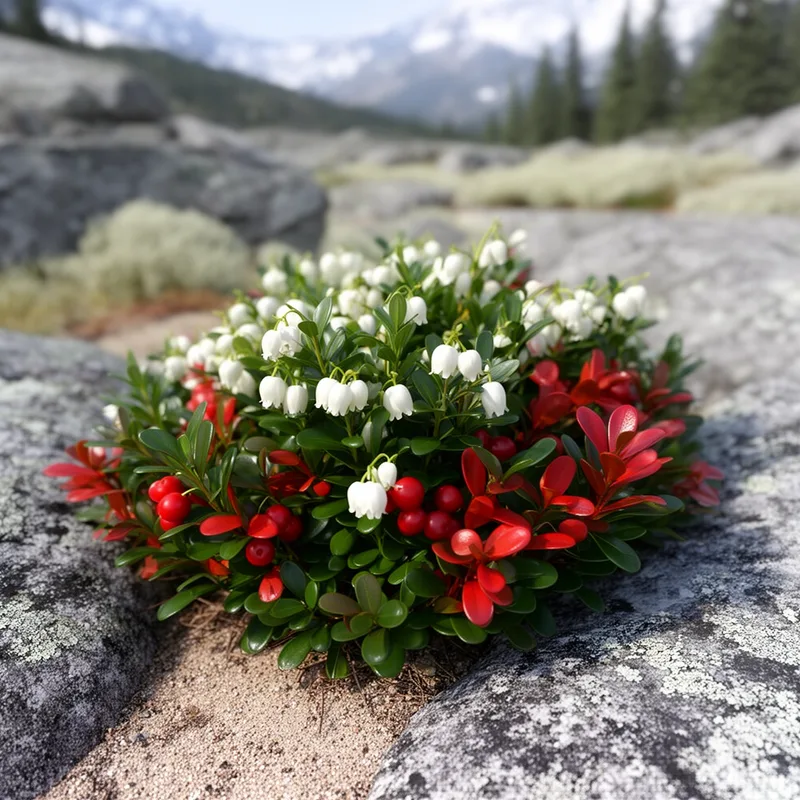
- In autumn, the leaves of the common bearberry turn a striking red color.
Examples
-
The common bearberry thrives in rocky soils and is often found in alpine regions.
-
Wildlife such as bears and birds are known to eat the berries of the common bearberry.
-
The common bearberry thrives in rocky soils.
-
Many common bearberries grow in the forest.
-
In autumn, the leaves of the common bearberry turn a striking red color.
-
The common bearberry thrives in rocky soils and is often found in alpine regions.
-
Wildlife such as bears and birds are known to eat the berries of the common bearberry.
Synonyms


 1
9.5
1
9.5
A small bush with red berries that bears eat in cold places

A low, spreading bush with small white flowers, red berries, and leaves that turn red in autumn

A low plant that stays green all year with small white flowers and red berries

A low evergreen shrub with small white flowers, red berries, and leaves that turn red in autumn

An evergreen low bush with small white flowers, red berries, and leaves that turn red in autumn

A low bush that stays green all year and has small white flowers and red berries

An evergreen low shrub with small white flowers, red berries, and leaves that turn red in autumn

A low evergreen shrub with small white flowers and red berries whose leaves turn red in autumn

A low evergreen shrub with small white flowers, bright red berries, and leaves that turn red in autumn

A low evergreen bush with small white flowers, red berries, and leaves that turn red in autumn

A low evergreen shrub from North America and Eurasia with small white flowers and red berries
Surface Forms
Morphology
This is a straightforward adjective+noun composition: 'common' (typical, frequent) simply modifies the noun 'bearberry' (a type of shrub). A B1 learner who knows both constituent meanings can directly infer that 'common bearberry' refers to the typical/widespread kind of bearberry, so the phrase is transparently compositional.
Etymology
Common bearberry comes from a simple picture: a low evergreen shrub with bright red berries that wild animals, especially bears, eat. That's why the plant is called bearberry, and 'common' shows it is found in many places and is a usual kind.