
Arctostaphylos uva-ursi
- noun
- /ˌɑrktoʊˈstæfɪloʊs ˌjuːvəˈɜrsi/
- Specialized
- The low-growing Arctostaphylos uva-ursi provided a dense ground cover in the alpine garden.
Examples
-
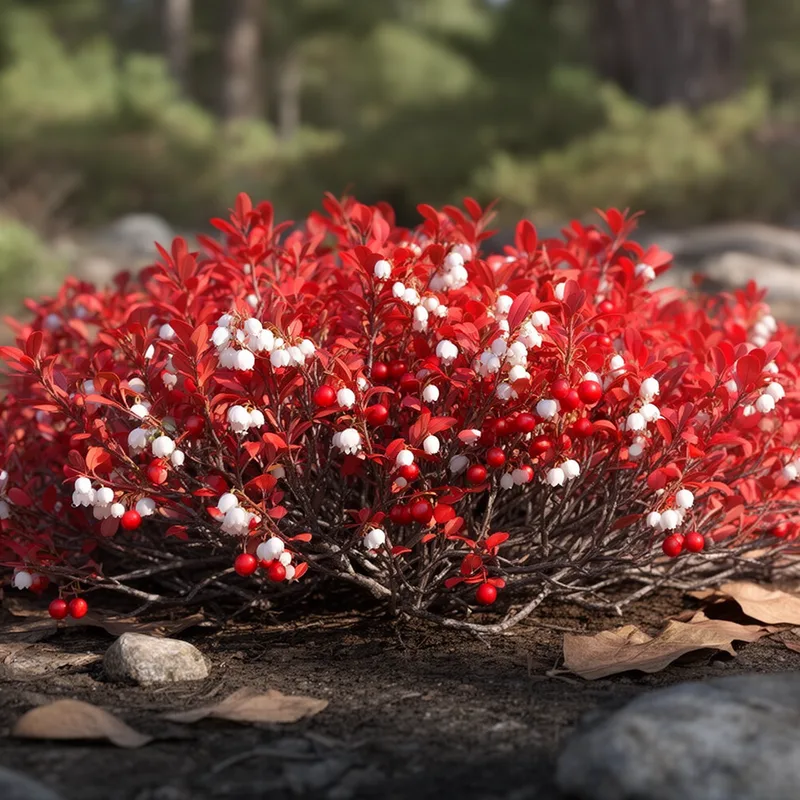
In autumn, the leaves of Arctostaphylos uva-ursi turn a vivid red, adding color to forest floors.
-
The low-growing Arctostaphylos uva-ursi, with its small white flowers, thrives in rocky areas.
-
Botanists studied the medicinal properties of Arctostaphylos uva-ursi leaves used in traditional remedies.
-
The Arctostaphylos uva-ursi is commonly found in rocky areas.
-
I planted Arctostaphylos uva-ursi in my garden this spring.
-
In autumn, the shiny leaves of Arctostaphylos uva-ursi turn a striking red, enhancing the landscape.
-
I often admire the Arctostaphylos uva-ursi plants in my garden for their vibrant red berries.
Synonyms

A low plant that stays green all year with small white flowers and red berries

A low evergreen shrub with small white flowers, red berries, and leaves that turn red in autumn

An evergreen low bush with small white flowers, red berries, and leaves that turn red in autumn

A low bush that stays green all year and has small white flowers and red berries

An evergreen low shrub with small white flowers, red berries, and leaves that turn red in autumn

A low evergreen shrub with small white flowers and red berries whose leaves turn red in autumn

A low evergreen shrub with small white flowers, bright red berries, and leaves that turn red in autumn

A low evergreen plant with small white flowers and red berries found in northern regions

A low evergreen bush with small white flowers, red berries, and leaves that turn red in autumn

A low evergreen shrub from North America and Eurasia with small white flowers and red berries
Surface Forms
Morphology
Arctostaphylos + uva-ursi
This is a scientific Latin binomial (genus + species) rather than a compositional English phrase; the parts are proper names and not interpretable as ordinary English vocabulary by a B1 learner. The species element 'uva-ursi' is not a common English word (and is not listed here), and even knowing Latin roots would not make the shrub meaning transparently derivable, so the expression is effectively idiomatic/technical and opaque to learners.
Etymology
Arctostaphylos uva-ursi comes from old Greek and Latin words: Arctostaphylos and uva-ursi, which mean 'bear' and 'grape'. Bears were often seen eating its round red berries, so the name means 'bear's grape' and helps you remember this low shrub with red berries.

