
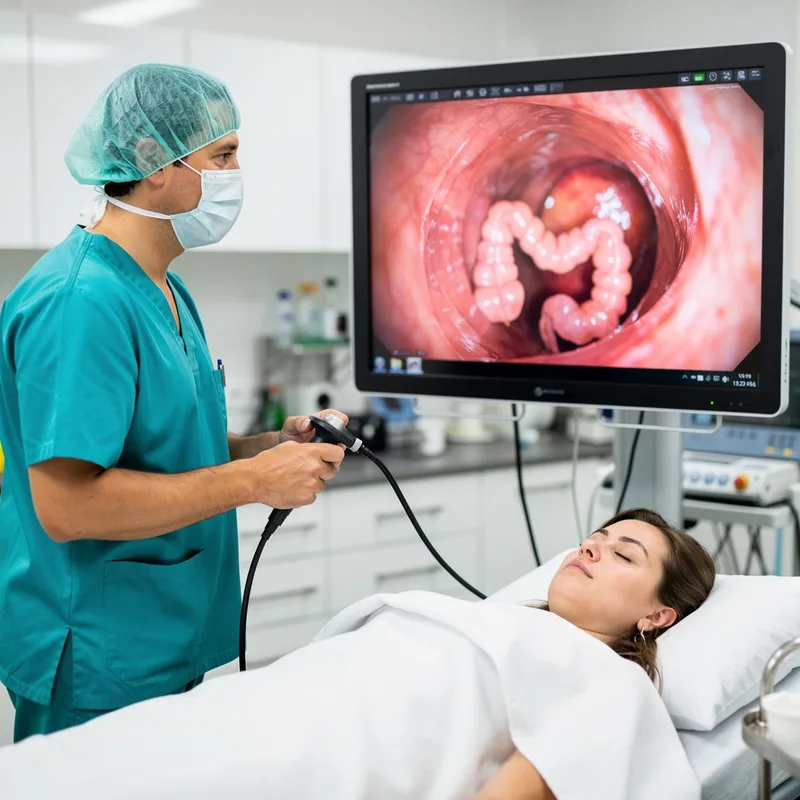
colonoscopy
 31
6.1
31
6.1

- noun
- /ˌkɒlənˈɒskəpi/
- Specialized
- The patient had undergone a colonoscopy approximately four years prior due to complaints of irritable bowel syndrome.
- colonoscopy or sigmoidoscopy
- colonoscopy or enema
- colonoscopy with barium
Loading YouTube…
Watch on YouTubeI mean, when you look at the studies, I think you know, how many people get colonoscopies way more often than they're supposed to.
- I mean, when you look at the studies, I think you know, how many people get colonoscopies way more often than they're supposed to.
- And that has to be weighed against the cost of the colonoscopy, both the financial cost and the risks, which are very low, but not zero.
- It may be that you need a colonoscopy in three years or in five years, but generally it's dependent on the pathology of that.
- Sometimes wash outs and colonoscopies can can do that.
- And then we would pick a random word like colonoscopy.
- Cancer, colonoscopy, prostate cancer, shoulder surgery.
- As far as this name and number to get my colonoscopy.
- I would probably say at my colonoscopy.
- I'm pretty sure Barack Obamas team has a Blu-ray of my colonoscopy with directors commentary.
- And like the rest of his GI tract, because to do a colonoscopy to go from the top up, you'd have the bottom up.
Examples
-
Similarly, the diagnostic test for colorectal cancer used in the UK is optical colonoscopy.
Academic text (2012) -
General guidelines recommend that the age for screening colonoscopies begin at 50 for people at average risk.
Blog text (15) -
...the results of your colonoscopy, so we're good.
-
I came directly from a colonoscopy procedure.
-
Meanwhile, I want to prep you for a colonoscopy.
-
When I turned 50, I had the obligatory colonoscopy that was normal.
Blog text (15) -
Participants with positive tests were asked to attend a full examination and were offered a colonoscopy whenever possible.
Academic text (1996) -
More than 85% of those with positive tests underwent full colonoscopy (Table 3).
Academic text (1996) -
We investigated patients aged 55 years or older by colonoscopy; younger patients were assessed by flexible sigmoidoscopy.
Academic text (2002) -
The doctor explained that a colonoscopy is necessary to examine the health of the colon.
Synonyms
 7
5.8
7
5.8
A medical test that uses a thin tube with a light and camera to look inside the body
How Extensive
- Specialized
31
6.1

- Specialized
Surface Forms
Morphology
Etymology
The word colonoscopy comes from colon, meaning 'large intestine', and -oscopy, a part meaning 'to look'. Think of it like using a scope, as in microscope, to 'look' inside the colon, which is why a colonoscopy is a medical exam to view the colon.