
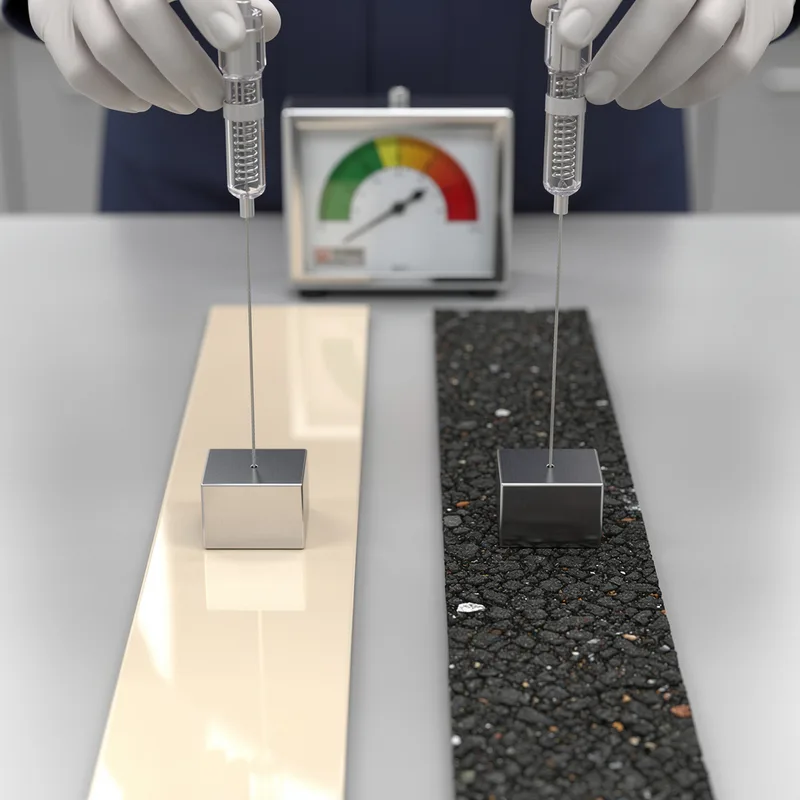
coefficient of friction
 1
6.4
1
6.4

- noun
- /ˌkoʊɪˈfɪʃənt əv ˈfrɪkʃən/
- Specialized
- In the experiment, a higher coefficient of friction resulted in better grip on the surface.
Loading YouTube…
Watch on YouTubeThough glass is a very smooth substance, glass on glass has one of the highest static coefficients of friction there is.
- Though glass is a very smooth substance, glass on glass has one of the highest static coefficients of friction there is.
- The it's called a coefficient of friction between a rubber tire and concrete.
Examples
-
Graphalloy metal-impregnated bearings maintain their constant low coefficient of friction over their entire operating lives and are not subject to seizures, binding, or sudden failure.
Academic text (1996) -
The maximum friction is given by (coefficient of friction) * (weight of plane).
Blog text (1) -
The plane does not move because there is a large enough coefficient of friction.
Blog text (1) -
Nylon would be a good fit here because it is strong, tough, and has a low coefficient of friction.
Blog text (16) -
If it's all about surface roughness, then why do really, really smooth materials have some of the highest coefficients of friction, just like rubber?
-
The coating is said to improve tool life by as much as 50 percent and displays a high coefficient of friction.
Academic text (2002) -
The series has consistently demonstrated coefficients of friction between 0.75 and 0.95.
Academic text (2000) -
Structural parts are made of high-strength ductile iron, and runners are made of UHMW polymer with a low coefficient of friction.
Academic text (1997) -
Leonardo extended the second observation to the definition of what he termed a coefficient of friction—that is, the ratio of the frictional force to the normal load N.
Academic text (1998) -
The engineer calculated the coefficient of friction to determine how much force was needed to move the object.
Antonyms

Surface Forms
Morphology
coefficient + of + friction
The phrase is compositionally built from 'coefficient' (a numeric factor) and 'friction' (resistance between surfaces), so its meaning as a numerical measure/ratio describing friction is directly derivable from the constituents. The grammatical 'of' simply links the modifier to the head, and equivalent constructions exist in many languages, making this term readily understandable to learners who know the component words.
Etymology
Coefficient of friction names a single number that tells how much two surfaces friction, or 'rubbing', against each other, with coefficient meaning 'a number' and friction meaning 'rubbing'. So imagine a small number sitting between a shoe and the floor that says 'how hard it is to slide' — that is why the phrase means how hard one object is to move over another.