

to clock on
- phrasal verb
- /klɑk ɑn/
- UK
- - He just clocked on and sat there, he hasn't moved since.
Examples
-
Or let Sternwood think we haven't clocked on.
-
I clock on, do the hard yards, and then I clock off.
-
And then as the shows went on, people started to clock on that she was wanting them to go mute.
-
As an employee, I've witnessed members of staff clocking on and immediately going home, to the pub, shopping...
-
At 9 AM sharp, I always clock on at the office to start my work day.
-
After a short break, he went back inside to clock on for the afternoon shift.
-
The employees must clock on using the time card system as soon as they arrive.
Synonyms

 10
3.2
10
3.2

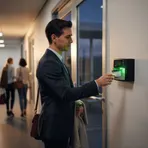
Use a machine to show the time you arrive at work
 5
3.5
5
3.5
Record the time you arrive at work using a time clock or electronic system
Antonyms
Surface Forms
Morphology
The meaning 'to record the time one arrives at work' follows directly from combining 'clock' (to record time) with the particle 'on' indicating engagement/commencement; this is a regular verb+particle composition akin to 'clock in'. Because the components map closely onto the phrase meaning and similar constructions exist cross-linguistically, a B1 learner who knows the parts can infer the MWE.
Etymology
Clock on comes from the old habit of using a time clock at work. Workers would put a card or press a button on the machine to show when they started their shift, so today clock on means 'to record the time one arrives at work'.