
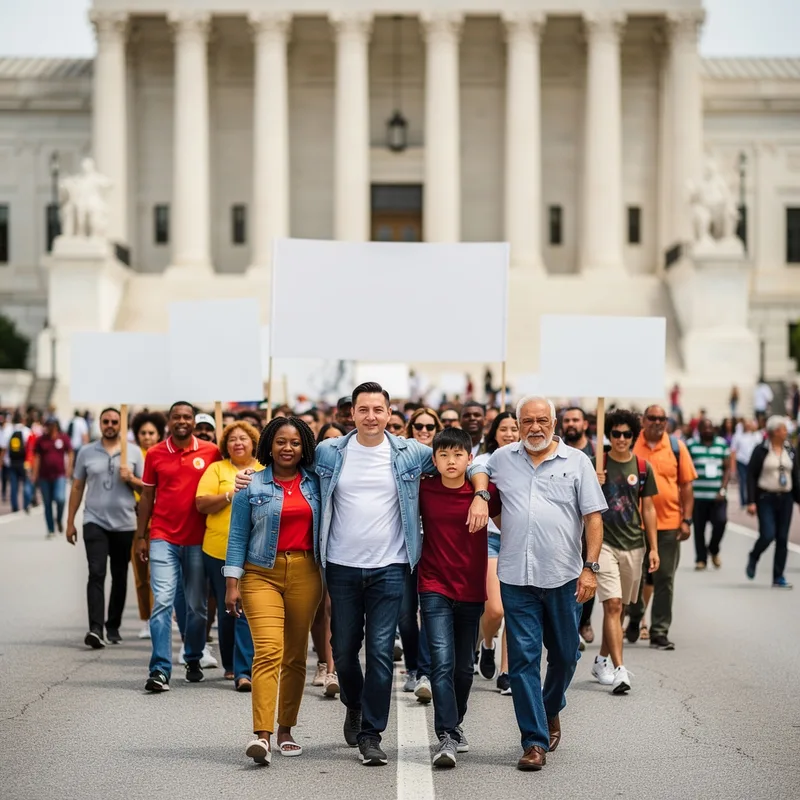
civil rights march
 2
3.4
2
3.4

- noun
- /ˈsɪvəl raɪts mɑrtʃ/
- During the civil rights march, activists carried signs demanding an end to discrimination.
- civil rights march in Selma
- civil rights march on Washington
- 1963 civil rights march
Examples
-
During the civil rights march of MLK, he told poor white people, "You should be marching along with us," because he knew they weren't being paid fairly and the wealthy despised them as well.
Blog text (33) -
A few months after the Forsyth County civil rights march, legislator Frank Redding introduced several proposals to change the design.
Academic text (2008) -
Catherine, actually, civil rights marches had a lot of white faces.
Blog text (16) -
The global society should have progressed far beyond the years of civil rights marches and fights for human dignity.
Academic text (2016) -
You wouldn't have found an ex-president marching in that first civil rights march.
Blog text (16) -
The civil rights marches were always disciplined in focusing only on civil rights, for instance.
Blog text (26) -
It transported me back to a time of campus protesting and civil rights marches.
Blog text (3) -
Selma, for example, "is still working hard to abandon its segregated past" (Stone 2000, 106) thirty-five years after the famous civil rights march across the Edmund Pettus Bridge.
Academic text (2003) -
Last summer, I participated in a civil rights march that aimed to promote racial equality.
-
The civil rights march in Washington drew thousands of people seeking justice and equality for all.
Synonyms
 161
2.6
161
2.6
A public walk for people to show support or protest for a cause
 5
3.4
5
3.4
A public walk by many people to show they disagree and ask for change

A public gathering where people protest unfair treatment because of race
How Large

Surface Forms
Morphology
The phrase is directly compositional: 'civil' + 'rights' denotes legal or social entitlements and 'march' denotes an organized public procession, so together they describe a protest advocating civil rights. This is a common, transparent noun phrase pattern found across languages, so a B1 learner who knows the constituents will readily understand the meaning.
Etymology
Civil rights march comes from the simple image of many people walking together in a march to show they want fair treatment. Because they walk in public to ask for change, the phrase now means 'a public protest for civil rights'.