

cinnabar moth
- noun
- /ˈsɪnəˌbɑr mɔθ/
- UK
- Farmers welcomed the introduction of the cinnabar moth to help control invasive ragwort.
Examples
-
The distinctive markings of the cinnabar moth make it easy to spot in meadows and grasslands.
-
We noticed dozens of cinnabar moths fluttering above the wildflowers on our hike.
-
The cinnabar moth is known for its bright red wings.
-
Have you ever seen a cinnabar moth up close?
-
Farmers welcomed the introduction of the cinnabar moth to help control invasive ragwort.
-
The distinctive markings of the cinnabar moth make it easy to spot in meadows and grasslands.
-
We noticed dozens of cinnabar moths fluttering above the wildflowers on our hike.
Synonyms
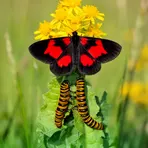
A red and black moth whose caterpillars eat ragwort leaves
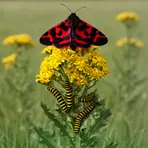
A large red and black European moth whose caterpillars eat the weed ragwort
How Red
- UK

Surface Forms
Morphology
The compound is fully compositional: 'cinnabar' specifies a color/species and 'moth' names the insect, so 'cinnabar moth' straightforwardly denotes a moth that is cinnabar-colored or the species called cinnabar. This noun–noun modifier + head pattern is common in English and cross-linguistically, so a B1 learner who knows both constituents can infer the meaning.
Etymology
Cinnabar moth is named after the bright red pigment cinnabar. People thought the moth's bright red and black wings looked like that 'red pigment', so cinnabar moth came to mean the 'red-and-black' moth.

