

Callimorpha jacobeae
- noun
- Specialized
- Biologists introduced Callimorpha jacobeae to North America to help manage invasive ragwort populations.
Examples
-
Farmers welcomed the arrival of Callimorpha jacobeae as an effective, natural means of controlling ragwort.
-
The caterpillars of Callimorpha jacobeae feed on ragwort and are easily recognized by their yellow and black stripes.
-
The caterpillars of the Callimorpha jacobeae are easily recognized by their yellow and black stripes.
-
The Callimorpha jacobeae is often seen in gardens during summer.
-
Have you ever spotted a Callimorpha jacobeae in the wild?
-
Farmers welcomed the arrival of Callimorpha jacobeae as an effective, natural means of controlling ragwort.
-
Biologists introduced Callimorpha jacobeae to North America to help manage invasive ragwort populations.
Synonyms
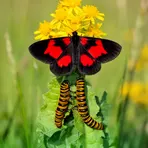
A red and black moth whose caterpillars eat ragwort leaves

A large European moth with bright red and black wings whose caterpillars eat ragwort
Surface Forms
Morphology
Callimorpha + jacobeae
This is a Latin binomial (genus + species). If a learner knows 'Callimorpha' (a genus of moths) they can infer it denotes a particular species of that moth, but the species epithet 'jacobeae' is Latin/opaque to a B1 learner and does not convey the specific attributes (red-and-black, ragwort-feeding), so the overall meaning is only partially transparent.
Etymology
Callimorpha jacobeae may come from Greek parts in Callimorpha meaning 'beautiful form' and from jacobeae, which links the moth to the plant 'ragwort' that its caterpillars eat. So the name points to the moth's bright, red-and-black look and to its habit of eating 'ragwort', which explains why people introduced it to help control that plant.

