
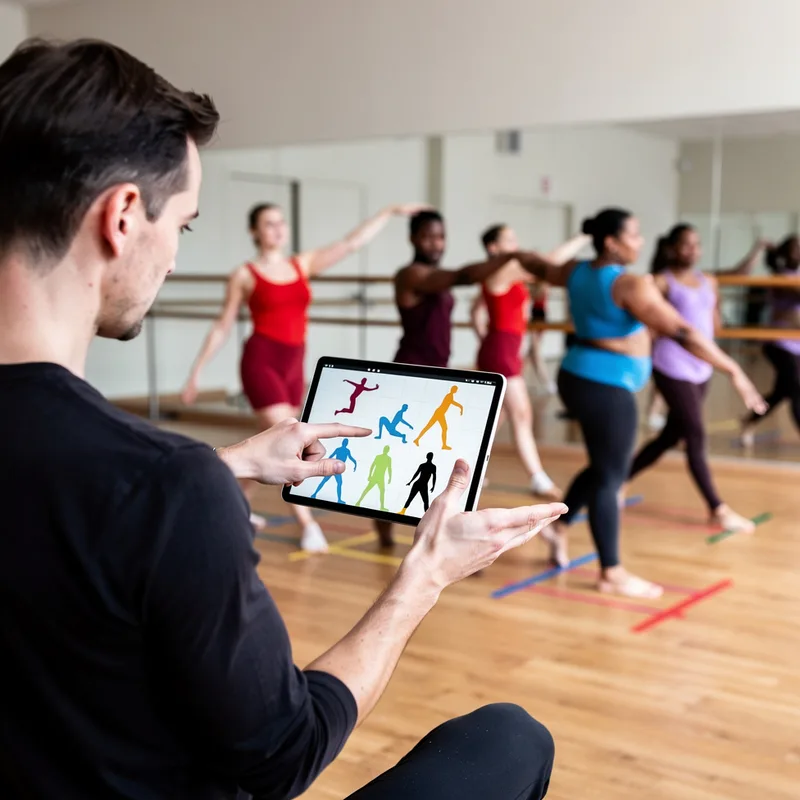
choreographic
 1
8.1
1
8.1

- adjective
- /ˌkɔːriəˈɡræfɪk/
 :
coreográfico
:
coreográfico
- Her choreographic masterpiece captivated the audience with its blend of elegance and precision.
- musical and choreographic
Examples
-
As creative talent, mukudj dancers continue to aspire not only to master well-established and demanding choreographic movements but also to introduce new elements that will simultaneously become integrated into the repertory and inextricably associated with their careers.
Academic text (1998) -
What is the effect of diversity on choreographic experiments?
Academic text (2000) -
Any student can learn choreographic "rules" and create studies through the use of them.
Academic text (1993) -
Correct technique involves choreographic perfection.
Academic text (2003) -
Chaos is why no two dancers, with the same choreographic map, can ever dance alike.
Academic text (1994) -
There was a strong interplay between these women as dancers and his choreographic vision.
Academic text (2000) -
His choreographic statement was not anti-humanity; he offered other ways of seeing humanity.
Academic text (1994) -
Seminal choreographic works contain their own distinct signatures, with specific motifs, gestures, and uses of weight and space.
Academic text (2000) -
To some degree, Balanchine's choreographic creativity was spurred by his emotional and erotic exaltation of certain female dancers who served as his muses.
Academic text (2000) -
The choreographic routine involved intricate movements that showcased the dancers' skills.
How Planned

Surface Forms
Morphology
choreographic = choreography (transparent) = choreography + ic
Clearly formed from the noun 'choreography' with the adjective-forming suffix '-ic', yielding 'relating to choreography'.
Etymology
Choreographic comes from Greek parts: choreo- from choros meaning 'dance', like the word chorus, and -graphic meaning 'to write' or 'draw'. So choreographic is about 'writing' or arranging dance moves, which is why we use it for the way a dance is planned and put together.