
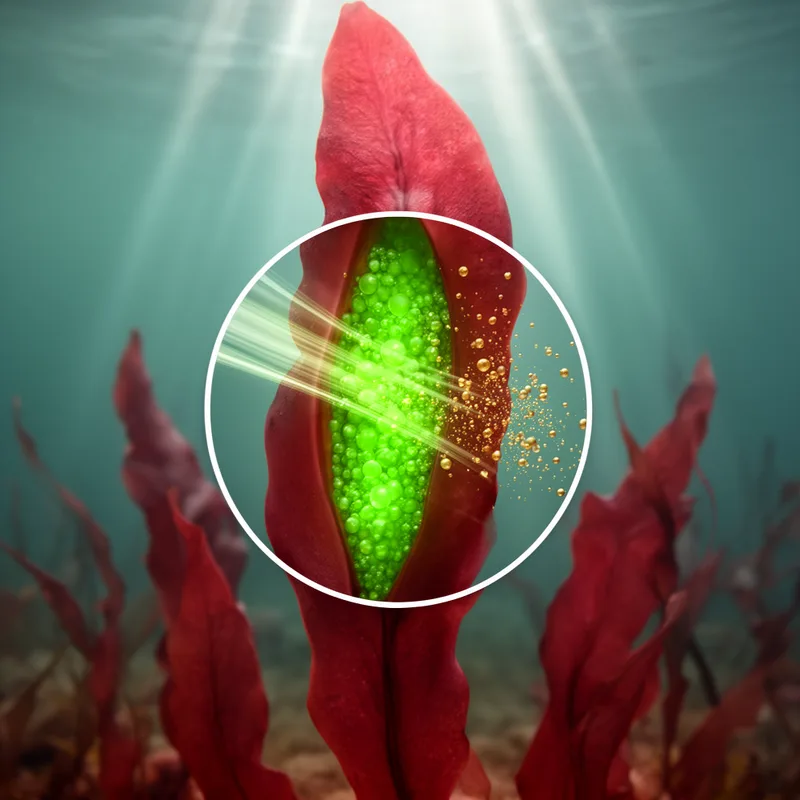
chlorophyll d
- noun
- Specialized
- Red algae contain chlorophyll d in addition to other pigments for photosynthesis.
Examples
-
Unlike most land plants, some marine species have high concentrations of chlorophyll d.
-
Scientists study chlorophyll d to understand how red algae absorb different wavelengths of light.
-
Researchers discovered chlorophyll d in red algae.
-
What role does chlorophyll d play in photosynthesis?
-
Chlorophyll d allows red algae to absorb light efficiently for photosynthesis in deeper waters.
-
Scientists have discovered that chlorophyll d plays a crucial role in the photosynthetic process of certain red algae.
-
Research shows that chlorophyll d is essential for red algae to thrive in low-light aquatic environments.
Surface Forms
Morphology
chlorophyll + D
The phrase combines 'chlorophyll' (a plant/light-absorbing pigment) with the letter 'D' acting as a variant label, so a learner who knows both constituents can infer it denotes a specific type or form of chlorophyll. Lettered labels for chemical/biological variants are common cross-linguistically, making the compositionally derived meaning transparent to B1 learners.
Etymology
The noun chlorophyll d names a specific form of chlorophyll, a word that literally means 'green leaf', and the letter d shows it is a different kind. This pigment is found in some red algae and helps them catch light that other chlorophylls miss, so the name shows it is a special 'green leaf' pigment used to get energy from light.

