
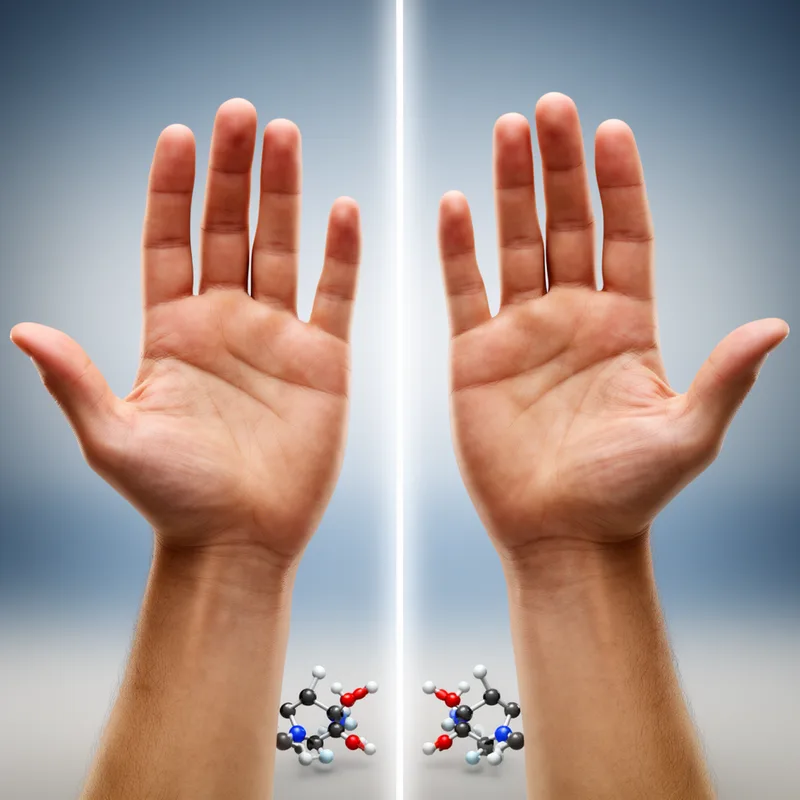
chirality
 1
9.8

- noun
- /kaɪˈrælɪti/
- Specialized
- Molecules with chirality can be found in both nature and synthetic chemistry.
- chirality is a property
Loading YouTube…
Watch on YouTubeOne of them had to do with the chirality, which way the spin was or which way the the alpha was oriented relative to the momentum.
- One of them had to do with the chirality, which way the spin was or which way the the alpha was oriented relative to the momentum.
Examples
-
This selectivity, known as chirality, is not associated with any known nonbiological processes (with the tiny exception of the weak nuclear force, which generates a minuscule excess of the left-handed variety).
Academic text (1996) -
In rheumatology, the importance of chirality is well illustrated by penicillamine.
Academic text (1991) -
So let me show you molecules that have the chirality that distinguishes them.
-
But because of chirality, AB is distinguishable from BA.
-
Chirality makes gossypol difficult to analyze and separate.
Academic text (2005) -
It's interesting chemistry, which perhaps takes origin-of-life chemistry one step further towards solving the chirality problem for one particular amino acid.
Blog text (14) -
The chirality of organic molecules is now described by the R (rectus) or S (sinister) convention.
Academic text (1991) -
Massless spin-1/2 particles such as u and d quarks possess chirality; they are either left- or right-handed.
Academic text (1999) -
Understanding chirality is essential for developing effective pharmaceuticals.
-
The concept of chirality helps chemists create substances that interact uniquely with biological systems.
Synonyms

A property of being mirror images that cannot be placed on top of each other, like left and right hands
Surface Forms
Morphology
Etymology
Chirality comes from the Greek root cheir, which means 'hand'. So chirality means 'handedness' — like a left and a right hand are mirror images that do not match when put on top of each other, and scientists use the word the same way for molecules and objects.