

chiral
 1
8.6

- adjective
- /ˈkaɪrəl/
- Specialized
- Finding a clear chiral signature in cometary organics would be evidence of a biological origin.
- chiral molecule
- chiral symmetry
Examples
-
Every week, Dowd produces several grams of pure chiral gossypol—a bright-yellow powder he keeps in the dark because of its light sensitivity.
Academic text (2005) -
Even more subtle effects may arise from drug interactions of a non-chiral drug with one that is chiral.
Academic text (1991) -
Different chiral forms of a drug may have different biological properties and clinical expressions.
Academic text (1991) -
So that means this next carbon here isn't chiral anymore, right?
-
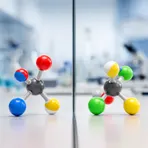
Such molecules that have we say a handedness are called chiral, chiral from the Greek word for hand.
-
Furthermore, although there may be more than one chiral center in a molecule, only one overall sign of rotation can be measured.
Academic text (1991) -
The clinical implications of such chiral inversion in humans remain unclear.
Academic text (1991) -
Chiral molecules, like those found in DNA, are not identical to their mirror images.
-
Chemists often study chiral compounds to understand their unique properties and behaviors.
-
The term chiral is used to describe objects that cannot be superimposed on their mirror images, such as left and right hands.
Synonyms

 1
9.9
A molecule that is a mirror image of another but cannot be placed on top of it to match
 1
9.9
A shape that is a mirror image of another but cannot match it by turning, like left and right hands
Surface Forms
Morphology
chiral = chir + al
The word is built on a Greek combining form meaning 'hand' plus '-al', but the base is not a standalone English word and the scientific meaning is not guessable for most learners.
Etymology
Chiral comes from the Greek root cheir meaning 'hand', so think of left and right hands: they are mirror images but not the same. That's why a chiral object or molecule has 'handedness' and cannot be placed on top of its mirror image.