
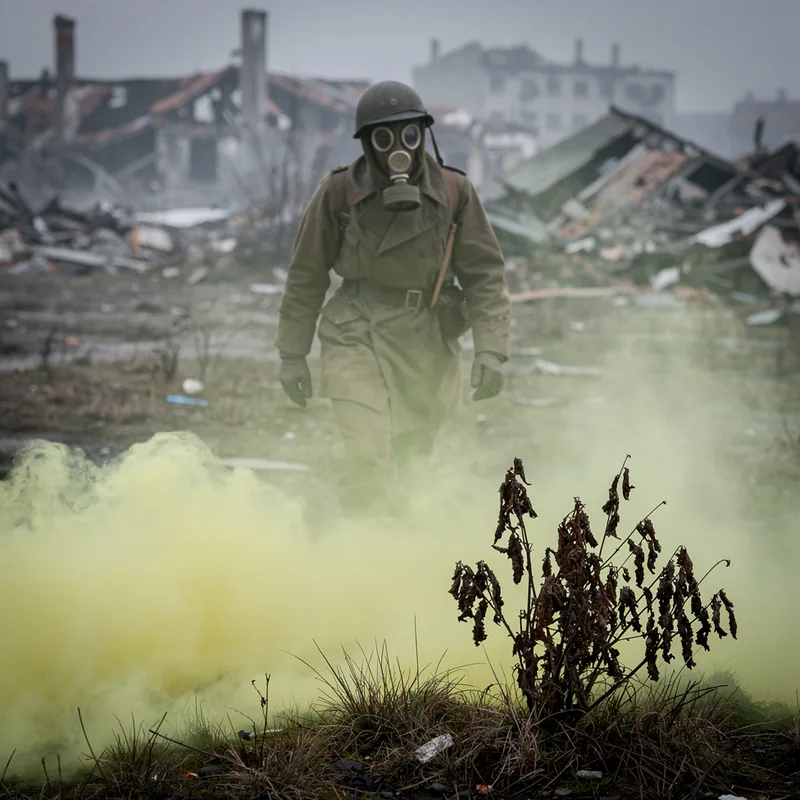
chemical weapon
 176
4.6
176
4.6

- noun
- /ˈkɛmɪkəl ˈwɛpən/
- Literature
- The government has strict regulations to prevent the use of chemical weapons during conflicts.
- use chemical weapons
- produce chemical weapons
- carry chemical weapons
Loading YouTube…
Watch on YouTubeIsrael has chemical weapons, biological weapons, nuclear weapons.
- Israel has chemical weapons, biological weapons, nuclear weapons.
- And AI has the capacity to make biological weapons and chemical weapons on paper.
- He sells standard and chemical weapons to the highest bidder in the Middle East.
- You use Novichok or you use some other internationally outlawed chemical weapon.
- And at the same time you have Joe Biden saying any use of chemical weapons will be met with a quote, severe price.
- As I've stated it's one to make sure that we destabilize Syria Hitler who didn't even sink to the to the to using chemical weapons.
- But they had played that chemical weapon warfare stuff so high, so much that everybody was extremely paranoid over that.
- And Ambrose was part of the chemical weapons scientists that were of great interest to the United States.
Examples
-
We will still need trained inspection teams to look for biological and chemical weapons.
Academic text (2001) -
Long went missing from the tech center along with a dangerous chemical weapon.
-
So there is an agreement that if you get rid of your chemical weapons, you can keep on killing.
-
Just look at the debate on the chemical weapons convention that is taking place in Congress today.
Academic text (1997) -
Biological and chemical weapons are much more difficult to detect and control than nuclear ones.
Academic text (2011) -
The United States has already destroyed one facility in Sudan in its attempt to target chemical weapons.
Academic text (1998) -
In addition to these similarities, these Arab governments all appear to have decided to use chemical weapons in similar circumstances.
Academic text (2017) -
In 1942, the U.S. Department of War built a chemical weapons plant northeast of Denver, Colorado.
Academic text (1999) -
All four states used chemical weapons in a broader military conflict and not as stand-alone events.
Academic text (2017) -
Putin was able to achieve this when he forced President Obama's hand over the chemical weapons issue in Syria.
Academic text (2015)
How Toxic
- NSFW
13
8.8

- Literature
176
4.6
- Specialized

 1
9.5
15
6.0
1
9.5
15
6.0
Surface Forms
Morphology
The meaning 'a weapon that uses toxic chemical substances' is directly and transparently derived from combining 'chemical' (relating to chemical substances) with 'weapon' (an instrument for harm). This straightforward adjective + noun composition is cross-linguistically common and should be understandable to a B1 learner who knows both constituent words.
Etymology
The phrase chemical weapon comes from the simple idea of a 'weapon' that uses dangerous 'chemicals'—poisonous gases or liquids that can hurt or kill people, animals, or plants. That's why today it means any weapon that works by releasing these poisonous chemicals.