
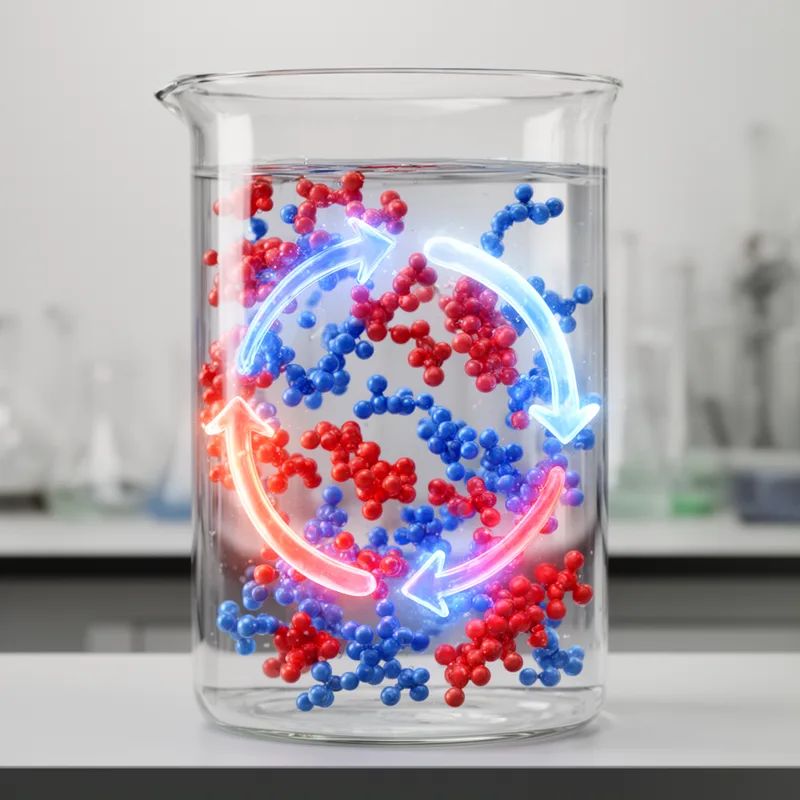
chemical equilibrium
 1
5.1
1
5.1

- noun
- /ˈkɛmɪkəl ˌiːkwɪˈlɪbriəm/
- Specialized
- When a system is in chemical equilibrium, the concentrations of reactants and products remain constant over time.
Examples
-
Considering mechanical equilibrium is reached before chemical equilibrium, the displacement components are obtained by solving the equilibrium equation. Formula omitted.
Academic text (2018) -
When neutrons and protons are in chemical equilibrium, their relative abundance is determined by the usual Boltzmann exponential.
Academic text (2004) -
But first let's talk a little bit about chemical equilibrium, the subject for today.
-
I tell you, take the view graph on say chemical equilibrium and talk about it.
-
The rotation of the Earth is slowing down at a rate of point zero, zero, zero, zero, zero, zero, zero... six miles per hour each day, disrupting the chemical equilibrium in the human brain, causing very irrational criminal behavior.
-
The underlying control on microstructural evolution, and the position of any rock on the spectrum, is essentially the extent to which the system departs from chemical equilibrium.
Academic text (2018) -
They fit various atmospheric models to their data, which take into account radiative transfer and chemical equilibrium, but do not take into account haze or photoionization.
Blog text (7) -
In thermodynamics, a thermodynamic system is said to be in thermodynamic equilibrium when it is in thermal equilibrium, mechanical equilibrium, radiative equilibrium, and chemical equilibrium.
Blog text (18) -
In a closed container, the gases reached chemical equilibrium, with the rates of the forward and reverse reactions balancing each other.
-
Understanding chemical equilibrium is essential for predicting how reactions will behave under different conditions.
Synonyms
 20
7.4
20
7.4
A state in a chemical reaction when the forward and backward reactions happen at the same speed
Surface Forms
Morphology
The meaning is directly derivable from combining 'chemical' (relating to chemistry or chemical processes) with 'equilibrium' (a balanced or steady state), so a learner who knows both constituents can infer it refers to a balanced state in a chemical reaction. This is a regular noun-modifier composition found across languages and follows standard English formation, making it immediately comprehensible to B1 learners.
Etymology
Chemical equilibrium paints a picture of a doorway where as many people go in as go out. That image explains it: equilibrium means balance and chemical shows it happens in a reaction, so the forward and backward steps happen at the same speed and the amounts of the chemicals 'stay the same'.