
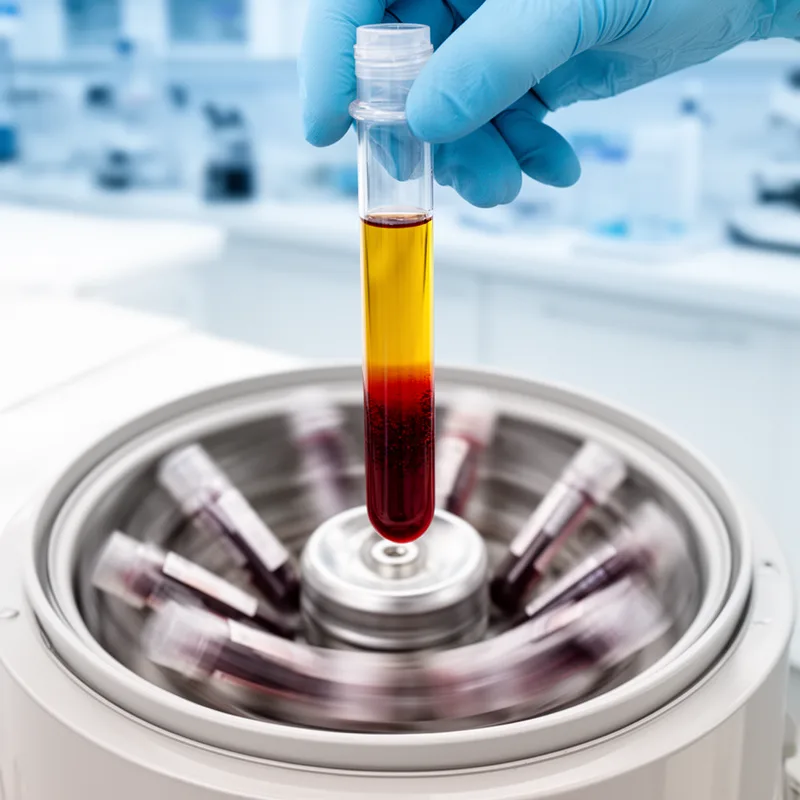
centrifugation
 1
7.7

- noun
- /ˌsɛntrɪfjuˈɡeɪʃən/
- Specialized
- At 80% confluence, cell harvesting was carried out using 0.25% (w/v) trypsin-EDTA (Gibco), followed by centrifugation at 300g for 5 minutes.
- centrifugation at 3,000 rpm
- centrifugation at 1000 g
- centrifugation for 10 minutes
Examples
-
Urine was collected in sterile containers and concentrated 10-fold by centrifugation and resuspension in one-tenth part of the original urine.
Academic text (1991) -
After immediate centrifugation, plasma was stored at 220 to 225 degrees Celsius in a portable, butane-charged freezer.
Academic text (2000) -
The sera were separated from the blood by centrifugation in the laboratory.
Academic text (2006) -
Following centrifugation, the aqueous layer was removed by aspiration.
Academic text (2015) -
Serum was harvested through centrifugation.
Academic text (2013) -
Following centrifugation, the supernatant was transferred to a new tube and then injected into cells.
Academic text (2013) -
Cells were lysed with glass beads and collected by centrifugation.
Academic text (2017) -
Bacterial cells were harvested by centrifugation at 4500 rev min-1 for 20 minutes.
Academic text (2013) -
The plasma collected by centrifugation for 10 minutes was either tested immediately or frozen and stored at 25°C.
Academic text (2007) -
The sera were separated from the blood by centrifugation in the laboratory.
Synonyms


 1
9.9
A process that separates tiny parts like proteins or viruses by spinning samples very fast in a machine
Antonyms

How Effective
- Specialized
1
9.9

- Specialized
1
7.7
10
3.2
- Specialized
2
6.0
- Specialized
Surface Forms
Morphology
centrifugation = centrifuge (transparent) = centrifuge + ation
Formed by the standard nominalizing suffix '-ation' added to the verb 'centrifuge' meaning 'the process of centrifuging'.
Etymology
Centrifugation comes from the same idea as centrifuge, which joins centre 'middle' and -fuge 'to flee', so it describes things being pushed away from the middle by spinning. So, centrifugation is the spinning process that forces heavier parts outward to separate them from lighter parts.