

cavernous sinus
 1
8.2
1
8.2

- noun
- /ˈkævərnəs ˈsaɪnəs/
- Specialized
- The cavernous sinus is a crucial structure that helps drain blood from the brain.
- cavernous sinus thrombosis
- left cavernous sinus
- right cavernous sinus
Examples
-
The mass displayed sharp borders that did not invade the cavernous sinus.
Academic text (2004) -
Mechanisms proposed to explain the preference of third nerve involvement include pressure transmitted to the cavernous sinus by the growing or invading tumor and compression of the third nerve between the tumor and the interclinoid ligament.
Academic text (2007) -
Figure 1. Case 1. Magnetic resonance image demonstrating recurrent disease within the left cavernous sinus (arrow).
Academic text (2002) -
The two patients had a similar course: protracted disease for more than six months with proptosis, vision changes, and late neurologic symptoms reflecting cavernous sinus invasion.
Academic text (2006) -
A cerebral angiogram showed an area of opacification within the anterior aspect of the left cavernous sinus consistent with thrombosis.
Academic text (2006) -
Six months later, he developed diplopia with a left abducent nerve paralysis, and recurrent disease was found within the left cavernous sinus (Figure 1).
Academic text (2002) -
In addition to bitemporal visual field loss, it may include colour desaturation, diplopia, and partial or complete ophthalmoplegia when tumours expand into the cavernous sinus.
Academic text (2007) -
Soft-tissue invasion of the mass extended into the maxillary sinuses and bilaterally to the pterygopalatine fossae, skull base, and the right cavernous sinus.
Academic text (2008) -
Preoperative contrast-enhanced CT demonstrates the extensive disease in the ethmoid, sphenoid, and maxillary sinuses, as well as in the cavernous sinus.
Academic text (2008) -
Patients can experience catastrophic complications, including carotid artery rupture, mycotic aneurysms, and cavernous sinus thrombosis.
Academic text (2008)
Synonyms
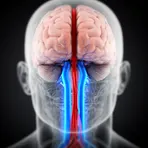
One of a pair of large veins at the base of the brain that drain blood from it
Surface Forms
Morphology
The compound is a straightforward adjective+noun composition: 'cavernous' describes having blood-filled cavities and 'sinus' denotes a venous channel, so the phrase literally denotes a venous channel with cavernous spaces. This type of modifier–noun naming pattern is regular and cross-linguistically common, so a B1 learner who knows both constituents can infer the general meaning even if they lack detailed anatomical knowledge.
Etymology
The name cavernous sinus comes from its look: cavernous means 'like a cave' and sinus means 'a hollow or channel'. These are large hollow channels inside the skull that collect and carry blood, so the name explains their job.