
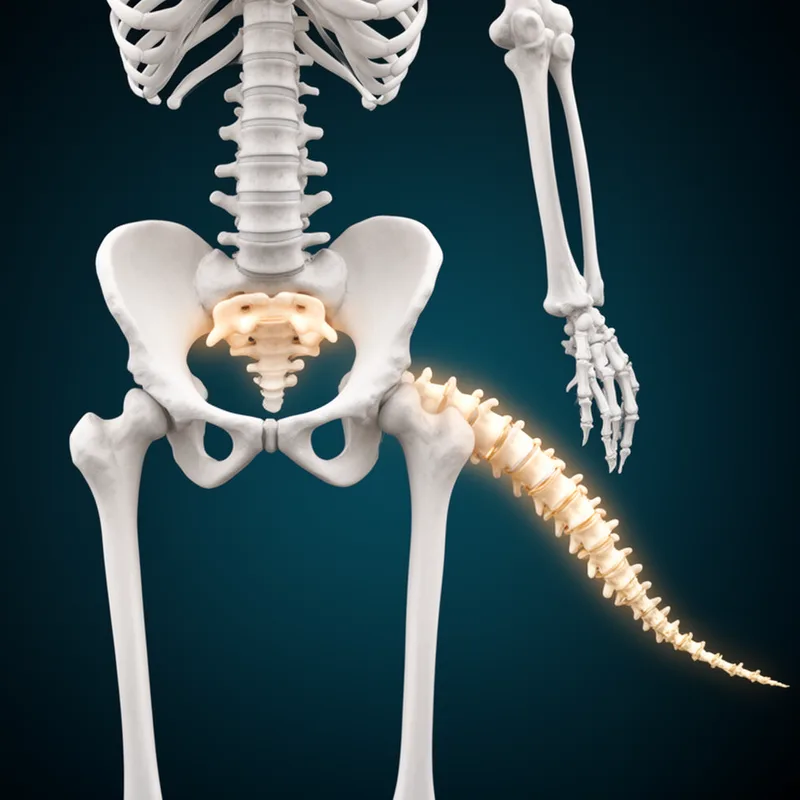
caudal vertebra
- noun
- /ˈkɔːdəl ˈvɜːrtɪbrə/
- Specialized
- The human coccyx consists of four fused caudal vertebrae.
Examples
-
The human caudal vertebra is important for tailbone structure.
-
In some animals, injuries to the caudal vertebrae can affect tail movement.
-
During evolution, the number of caudal vertebrae in humans was greatly reduced.
-
Many animals have a series of caudal vertebrae for tail support.
-
The doctor explained that the injury affected one of the caudal vertebra in the patient's spine.
-
Radiologists often analyze the caudal vertebra to assess any abnormalities in the coccyx.
-
During the anatomy class, we learned about the structure of the caudal vertebra and its role in the skeletal system.
Synonyms
 7
8.9
7
8.9

A small triangular bone at the base of the spine called the tailbone
 7
3.1
7
3.1
A small bone at the base of the spine that you sit on
A small bone at the base of the spine that joins others to make the tailbone

The small bone at the very end of the spine
Surface Forms
Morphology
The meaning 'a vertebra at the tail or rear end of the spine' is directly derivable from 'caudal' (related to the tail/rear) combined with 'vertebra' (a spinal bone). Although the term is technical/medical, the adjective+noun composition is compositional and cross-linguistically consistent, so a B1 learner who knows both constituents can infer the MWE's meaning.
Etymology
The term caudal vertebra comes from Latin words: caudal from 'cauda' meaning 'tail' and vertebra meaning 'a small spine bone'. So it literally names the bones at the tail end of the spine, like the bones that form the human coccyx.