
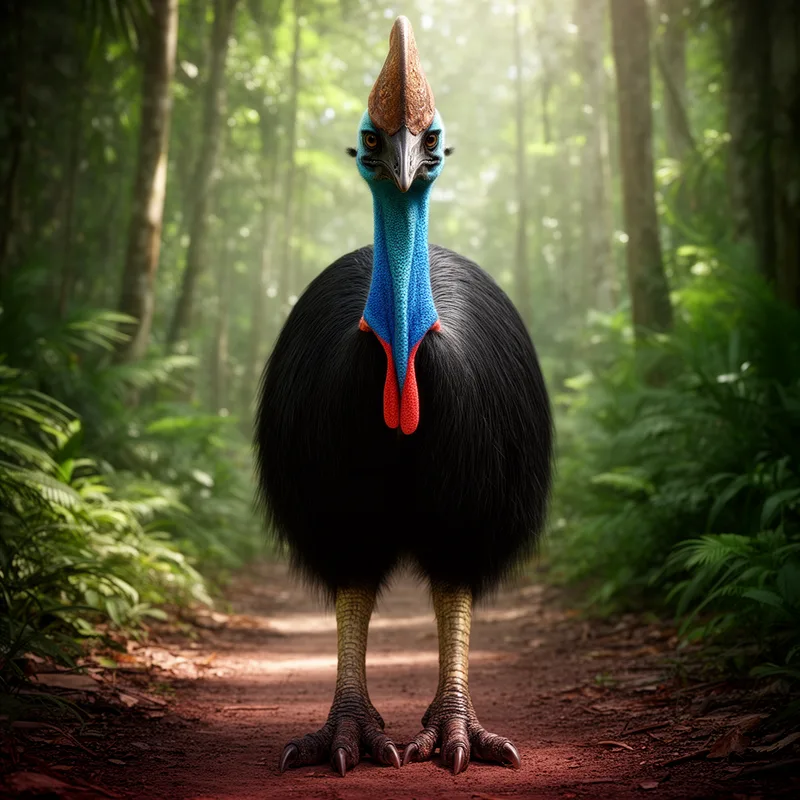
cassowary
 1
9.9

- noun
- /ˈkæsəˌwɛri/
- Australian
- The cassowary, known for its striking helmet-like crest, is a fascinating bird found in the rainforests of New Guinea.
- cassowary bird
Examples
-
(The hunter himself, at least of a wild pig, does not partake, and food taboos may prevent persons of certain categories from partaking; for example, all women are taboo from cassowary meat.)
Academic text (1992) -
Bali starlings, South American macaws, Australian cassowary, African crowned cranes, Tanzanian flamingos, and birds of paradise are just a few to mention.
Academic text (2001) -
The snake-hunting secretary bird of Africa, or the cassowary.
Fiction book (1990) -
Mother and I were both healthy... but the poor lizard escaped... and was trampled by a frightened cassowary.
-
In the past, men hunted small marsupials, wild pig, eels, snakes, cassowary, and small birds, which supplemented the supply of domestic pigs.
Academic text (1991) -
And this seems to be true in things like the fallaropes, polyandra, shore birds and cassowaries, and in button quail.
-
According to statements made by Sawiyano, other game animals such as marsupials and birds, especially cassowaries, were depleted from a former abundance because of the use of firearms by both Sawiyano and government station personnel.
Academic text (1992) -
In fact, the velociraptor conveyed precisely the same impression of deadly, swift menace Grant had seen in the cassowary, the clawed ostrich-like bird of New Guinea.
Fiction book (1990) -
While hiking in Australia, we spotted a magnificent cassowary walking gracefully through the dense vegetation.
-
The cassowary, a large flightless bird, uses its strong legs to navigate the thick underbrush of its tropical habitat.
Synonyms
A group of large flightless birds called cassowaries from Australia and New Guinea
A group of large flightless birds called cassowaries from Australia and New Guinea
How Big

Surface Forms
Etymology
Cassowary comes from the Malay word kasuari, the name local people used for this rainforest bird. So English uses it for the large, black, flightless bird with a helmet-like head crest.