

to carve a path


 1
4.2
1
4.2
- phrasal verb
- /kɑrv ə pæθ/
- America 2000 was never enacted, but it did carve a path for Clinton's Goals 2000 proposal, which supported states' development of standards (NYSED, 2009).
Examples
-
Two more canoes carved a path to the shore and beached upstream.
Fiction book (1994) -
Seth continues carving a path to the front door by slamming the hammer stake into vampire chests.
Fiction book (1996) -
Or, we can kick open that door and the four of us can hit 'em with everything we have and carve a path right through 'em to the front entrance.
Fiction book (1996) -
Donna Willard-Jones carves a path.
Academic text (2003) -
A trickle of water carving a path down a hill must take the easiest route available, not the route that would, at a later date, serve its needs better.
Blog text (8) -
The burden of getting the whales to the ridge... falls to a cock-eyed coalition of whale hunters and whale lovers... who must carve a path in record-time... and pray the whales follow their lead.
-
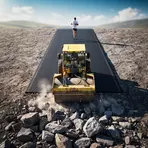
The explorers had to carve a path through the dense jungle to reach the hidden waterfall.
-
By launching her own business, she hopes to carve a path for other women entrepreneurs in the industry.
-
The team worked hard to carve a path towards a solution that would benefit everyone involved.
Synonyms
 56
3.7
56
3.7
Make it possible or easier for something to happen by getting things ready
 23
4.6
23
4.6
Make a place for yourself in a job or field by working hard

Make a new path through wild land by clearing plants and marking the route

Create chances to move forward in your career
Antonyms


How Pioneering

Surface Forms
Morphology
The meaning is directly derivable from combining 'carve' (to cut or make) with 'path' (a route): literally making a passage and metaphorically creating a way forward follow the same compositional logic. This figurative extension is a straightforward and common metaphor (make/open a way) across languages, so a B1 learner who knows the constituents will very likely infer the MWE meaning.
Etymology
The phrase carve a path may come from the image of someone using a tool to carve through trees or rock to make a path. That clear picture of making a way forward is why we use it to mean 'to create a route' or 'to make progress'.