

carotid artery
 15
3.8
15
3.8

- noun
- /kəˈrɒtɪd ˈɑːrteri/
- Specialized
- The patient is seated OK, and they have a carotid artery on the left side and a carotid artery on their right side.
- the internal carotid artery
- the external carotid artery
- the common carotid artery
Examples
-
During a cluster headache, the internal carotid artery floods with blood, exacerbating the intense pain.
Academic text (2011) -
Consequently, persons with carotid artery plaques are at increased risk for myocardial infarction.
Academic text (2012) -
I just checked his carotid artery.
-
I'll just check the carotid artery.
-
The internal and common carotid arteries were clamped while talking to the patient.
Academic text (2007) -
It's usually caused by a blockage in the carotid artery... that supplies blood to the brain.
-
Proximal and distal control of the carotid artery was established, and a suture repair of the vessel was attempted.
Academic text (2009) -
Patients can experience catastrophic complications, including carotid artery rupture, mycotic aneurysms, and cavernous sinus thrombosis.
Academic text (2008) -
The doctor pressed on the patient's neck to check the carotid artery for a pulse.
-
During the procedure, the surgeon carefully examined the carotid artery for any signs of blockage.
Synonyms

 1
3.3
1
3.3
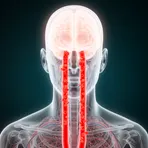
A large blood vessel on each side of the neck that carries blood to the head and brain

A large blood vessel in the neck that carries blood to the head and brain
Surface Forms
Morphology
The meaning is directly compositional: 'carotid' is an adjectival label specifying which artery, and 'artery' denotes a blood vessel, so a B1 learner who knows both constituents can infer it refers to the (neck) artery supplying the head. The construction follows standard anatomical naming patterns and has transparent cognates in many languages, supporting immediate comprehension.
Etymology
The noun carotid artery may come from an old Greek word that meant 'to stun' because pressing the large neck vessel called the carotid can make someone faint. Because these arteries carry blood to the head, the name links the place in the neck with that 'stun' effect.