
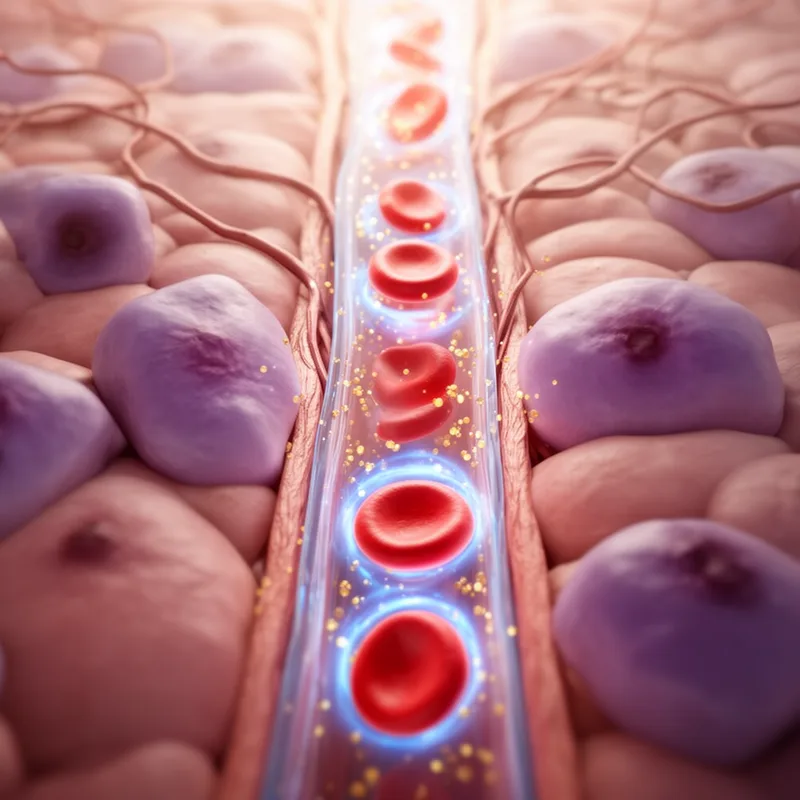
capillary vessel
- noun
- /ˈkæpɪˌlɛri ˈvɛsəl/
- Specialized
- Oxygen and nutrients pass through the walls of the capillary vessels to nourish surrounding cells.
Examples
-
The human body contains millions of capillary vessels.
-
The human body contains billions of capillary vessels that form an intricate network.
-
Damage to capillary vessels can lead to bruising under the skin.
-
Each capillary vessel plays a crucial role in nutrient exchange.
-
The doctor explained that oxygen and nutrients pass through the walls of a capillary vessel into the surrounding tissues.
-
When injuries occur, blood seeps from a damaged capillary vessel, causing bruising in the affected area.
-
In the lungs, carbon dioxide is exchanged for oxygen as blood flows through the capillary vessels surrounding the alveoli.
Synonyms

 11
4.8
11
4.8

A very small blood vessel that lets oxygen and nutrients move between blood and body tissues
How Small

Surface Forms
Morphology
The phrase's meaning is directly compositional: 'capillary' denotes a minute blood vessel and 'vessel' denotes a tubular structure carrying blood, so together they clearly indicate a very small blood vessel. This is a straightforward, cross-linguistically common noun+noun/adjective+noun composition and would be understandable to a B1 learner who knows both constituent words.
Etymology
Capillary vessel comes from a word meaning 'hair' because capillary describes tubes as thin as a hair and vessel means a blood tube. Picture tiny hair-like tubes where oxygen and nutrients move out of the blood into nearby cells — that's why capillary vessels means the 'smallest blood vessels' that allow this 'exchange'.