
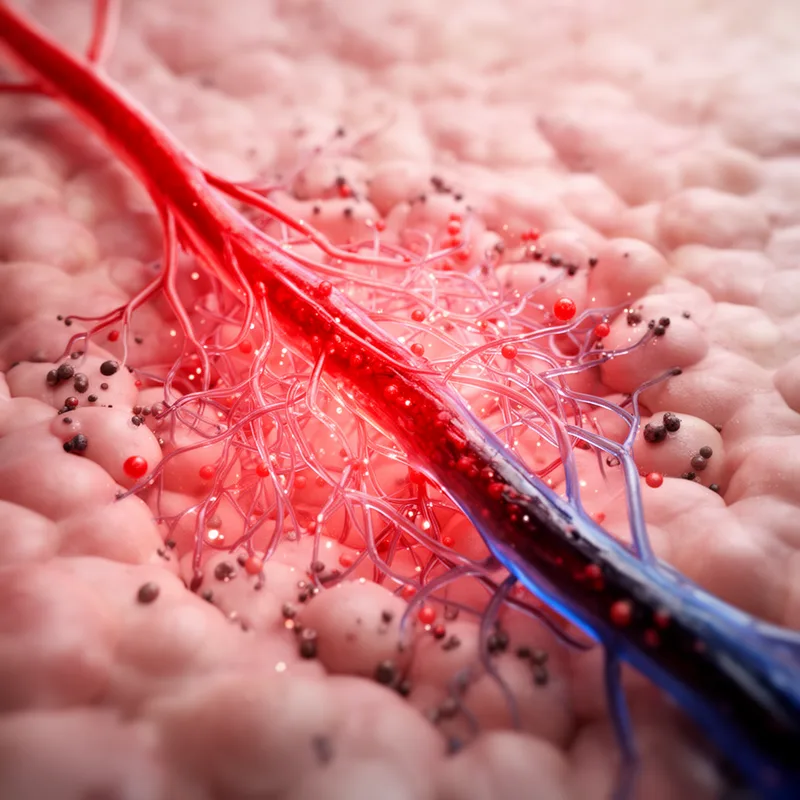
capillary bed
- noun
- /ˈkæpɪˌlɛri bɛd/
- Specialized
- Oxygen and carbon dioxide are exchanged in the tiny capillary beds throughout the lungs.
Examples
-
These areas occur where the capillary beds of one major artery come in contact with the capillary beds of another artery, such as those seen in the occipital lobe and brainstem.
Academic text (1994) -
And it's it's in these capillary beds which are illustrated here by these little meshes where you have the smallest diameter vessels.
-
These areas occur where the capillary beds of one major artery come in contact with the capillary beds of another artery, such as those seen in the occipital lobe and brainstem.
Academic text (1994) -
The capillary bed allows for the exchange of nutrients and oxygen between the blood and surrounding tissues.
-
Damage to the capillary beds can lead to swelling and bruising in the affected area.
Synonyms
A network of tiny blood vessels that carry blood through tissues
How Extensive


Surface Forms
Morphology
The compound is directly compositional: 'capillary' names the tiny blood vessels and 'bed' denotes a layer or area where something is found, so 'capillary bed' straightforwardly means a layer/network of capillaries. This follows regular noun–noun composition patterns in English (and similar constructions exist in many languages), making the meaning predictable for learners who know both constituents.
Etymology
Capillary bed makes a picture of many tiny tubes, each called a capillary, lying close together like a bed. Because blood flows through this 'bed', it can easily give oxygen and nutrients to nearby cells, so the term means 'a network of tiny blood vessels that allows exchange between blood and tissue'.