
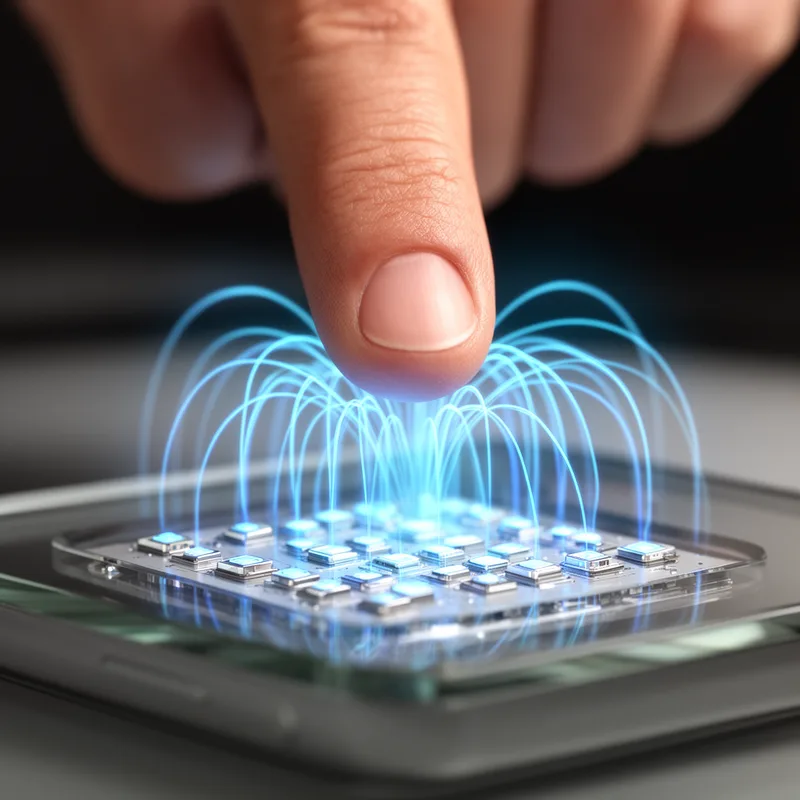
capacitive sensor
- noun
- /kəˈpæsɪtɪv ˈsɛnsər/
- Specialized
- Engineers developed a capacitive sensor to improve the accuracy of their devices in detecting motion.
Loading YouTube…
Watch on YouTubeOther robots have physical sensors like bump sensors or capacitive sensors that respond to touch, time of flight sensors, or other kinds of ways.
- Other robots have physical sensors like bump sensors or capacitive sensors that respond to touch, time of flight sensors, or other kinds of ways.
Examples
-
Proponents of capacitive sensors, including Freescale Semiconductor, say they consume less power.
Academic text (2005) -
A company in Los Angeles, Pressure Profile Systems Inc., markets a variety of capacitive sensors to accomplish exactly that.
Academic text (2007) -
Some sensor suppliers claim that capacitive sensors help to conserve battery power.
Academic text (2005) -
Other robots have physical sensors like bump sensors or capacitive sensors that respond to touch, time of flight sensors, or other kinds of ways.
-
The smart doorbell features a capacitive sensor that detects when someone approaches.
-
Many modern smartphones use a capacitive sensor for touch screen functionality.
Synonyms

 898
3.4
898
3.4

A device that notices heat, light, pressure, or movement and sends a signal
Surface Forms
Morphology
The noun phrase is directly compositional: 'capacitive' means related to capacitance and 'sensor' is a device that detects, so a 'capacitive sensor' is a sensor that detects via changes in capacitance. Although the concept is technical, the adjective+noun construction is transparent and would be understandable to a B1 learner who knows both constituent meanings.
Etymology
Capacitive sensor comes from the word capacitive, about the electrical 'capacity' or ability to hold a small electric charge, and sensor, a device that notices change. It works because a finger or object changes that tiny electric charge near the sensor, so the device can 'detect' presence or touch without physical contact.