

capacitive
 3
8.1
3
8.1

- adjective
- /kəˈpæsɪtɪv/
- Specialized
- The capacitive touch screen technology used with Apple's iPhone is an example of capacitive touch technology.
- capacitive sensor
- capacitive touch
- capacitive coupling
Loading YouTube…
Watch on YouTubeThe iPad isn't just a capacitive touch sensor.
- The iPad isn't just a capacitive touch sensor.
- Other robots have physical sensors like bump sensors or capacitive sensors that respond to touch, time of flight sensors, or other kinds of ways.
Examples
-
Nowadays, capacitive and resistive touchscreens are two of the most common types.
-
However, the capacitive touch screens are made from glass and are very durable.
Academic text (2008) -
You have these little capacitive touch buttons down here.
-
OK, so next thing is they have a capacitive touch function row of buttons.
-
It's a much better capacitive touch screen than the old Kindle Touch.
-
A company in Los Angeles, Pressure Profile Systems Inc., markets a variety of capacitive sensors to accomplish exactly that.
Academic text (2007) -
The capacitive touch technology used as the display and input technology is accurate, fast, reliable, and cost-effective.
Academic text (2008) -
Some sensor suppliers claim that capacitive sensors help to conserve battery power.
Academic text (2005) -
Unlike resistive and other technologies, capacitive touch technologies are capable of multiple touches simultaneously. This is called multitouch technology.
Academic text (2008) -
The new smartphone features a capacitive touch screen that responds quickly to light taps.
Compounds
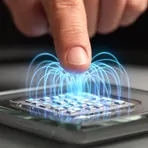
- Specialized
A sensor that detects objects by sensing small changes in electric charge
Surface Forms
Morphology
capacitive = capacitance (transparent) = capacit + ive
Formed by a standard adjectival suffix '-ive' from the noun 'capacitance', so the adjective directly means 'relating to capacitance'.
Etymology
The word capacitive comes from the same root as capacity and capable, from an old word meaning 'able to hold'. Think of a cup that can hold water: a capacitive thing 'holds' electric charge or energy in an electric field, which is why capacitive sensors can store electrical energy.