
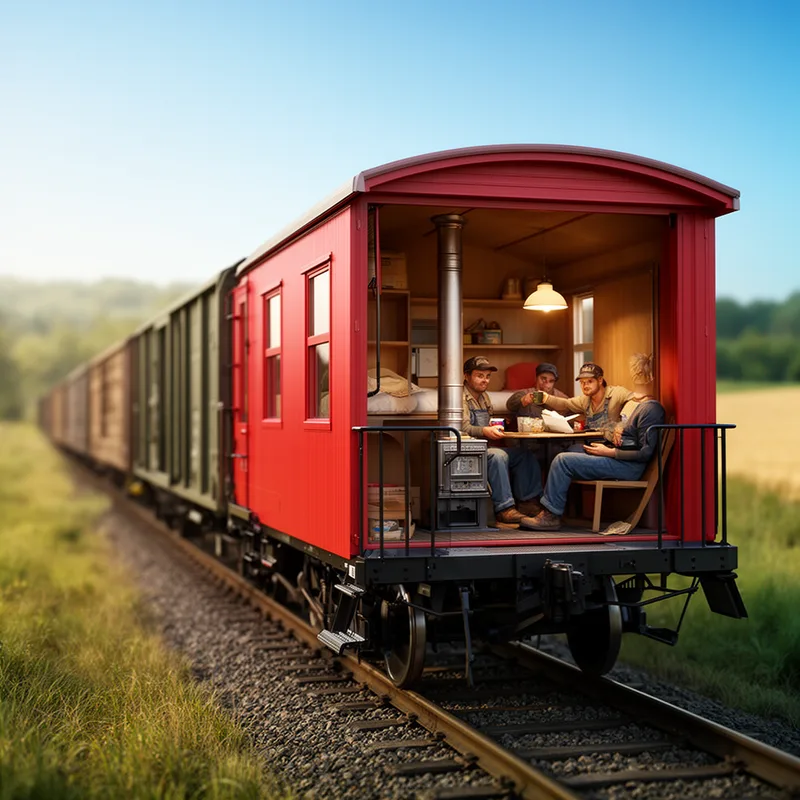
cabin car
- noun
- /ˈkæbɪn kɑr/
- Archaic
- The conductor walked to the cabin car at the rear of the train to check the manifest.
Examples
-
After leaving the locomotive, the crew relaxed together in the cabin car until their shift ended.
-
Old freight trains often had a red cabin car for the crew to rest in during long journeys.
-
The train's last car is a cabin car.
-
Have you seen the cabin cars at the station?
-
After leaving the locomotive, the crew relaxed together in the cabin car until their shift ended.
-
Old freight trains often had a red cabin car for the crew to rest in during long journeys.
-
The conductor walked to the cabin car at the rear of the train to check the manifest.
Synonyms

 130
5.7
130
5.7

A vehicle on tracks that carries passengers or goods
 6
2.5
6
2.5
A vehicle on railway tracks that carries people or goods
 5
3.7
5
3.7
A vehicle that runs on railway tracks to carry people or goods
 5
8.6
5
8.6
A small car at the end of a freight train where the crew live or work
 1
2.3
1
2.3
A vehicle that runs on tracks and carries people or goods


 1
9.1
1
9.1
The last car on a freight train that used to be a small home or office for the crew
Surface Forms
Morphology
The meaning is directly derivable from 'cabin' (a small enclosed room) + 'car' (a railroad vehicle): a rail car that contains a cabin for crew use. This straightforward noun–noun composition follows common compounding patterns in English (and similar constructions in other languages), so a B1 learner who knows both constituents can infer the MWE's meaning.
Etymology
Cabin car comes from the image of a small cabin built on the back of a train car, where the crew would sleep and rest on long journeys. That's why it means 'a railroad car for the train crew'.