

burial mound
 4
7.1
4
7.1

- noun
- /ˈbɜːriəl maʊnd/
- Old Indian burial mounds are common in and around the Great Swamp.
Loading YouTube…
Watch on YouTubeIncluding Bronze Age Kirigsur burial mounds, deer stone megaliths, ancient city fortifications.
- Including Bronze Age Kirigsur burial mounds, deer stone megaliths, ancient city fortifications.
Examples
-
Fifty miles south of Oslo lie the ruins of Oseberghaugen, a Viking burial mound.
-
In this flat landscape, the raised burial mounds are clearly visible
Academic text (2007) -
The burial mounds marked the place where the ancestors turned to dust.
Fiction book (1990) -
When they founded this place back in the 1400s, they found burial mounds everywhere.
-
When I happened upon his grave last summer, I had difficulty recognizing it: the burial mound had caved in and was overgrown with weeds.
Fiction book (1993) -
There are also, of course, important known sites that await scientific investigation, such as the burial mound of China's first emperor, Shihuangdi, who died in 221 B.C.
Academic text (2006) -
In Ghana and the Côte d'Ivoire, terracotta sculptures have been found in burial mounds on the same latitude.
Academic text (2000) -
In this flat landscape, the raised burial mound is clearly visible.
Synonyms


 1
9.5
1
9.5
A large round mound of earth or stones covering an old grave
 1
9.9
1
9.9
A mound of earth and stones made over a grave in ancient times
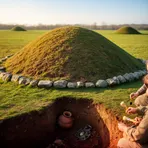
A heap of earth built over a grave in ancient times
How Big

Surface Forms
Morphology
The meaning is directly derivable from combining 'burial' (interment of a dead body) with 'mound' (a raised area of earth): a burial mound is simply a mound associated with burial. This noun–noun composition follows regular, cross-linguistically common compounding patterns, so a B1 learner who knows both words should understand the MWE.
Etymology
Burial mound comes from the simple picture of people piling a mound of earth or stones over a burial or 'grave' long ago. That's why it means a man-made hill built over a 'tomb' to mark or protect the dead.