

to brick in
 1
7.0
1
7.0

- phrasal verb
- /brɪk ɪn/
- Despite their best efforts, neo-Nazis and revisionists hit a brick wall in the West.
Examples
-
This time, the right side wall was also completely bricked in.
Fiction book (1994) -
They showed him how to create one from a recess behind a loose brick in a wall, or under a tombstone, in a crevice in an old tree, or beneath a flagstone.
Fiction book (1994) -
The builders bricked in the old door to improve the building's security.
-
After the renovation, they bricked in the unused fireplace to create more space.
-
During the remodeling, the contractors bricked in the large window to enhance insulation.
Synonyms
 66
1.9
66
1.9
To put something into a hole to stop a flow
 41
6.4
41
6.4
To surround an area with a wall to protect it
 7
5.8
7
5.8
To build a barrier around something to keep people in or keep others out
 3
6.1
3
6.1
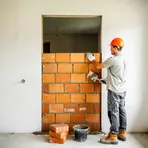
Close an opening by building a wall across it
 2
5.2
2
5.2
To close an opening by building a solid wall of blocks


 1
6.7
1
6.7
To close an opening like a door or window by building a brick wall across it
 1
5.6
1
5.6
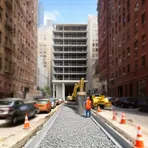
To fill a space with material or build on empty land between buildings in a city

To build a wall around something to protect or separate it
Antonyms

Surface Forms
Morphology
The meaning 'to close off or fill an opening by building a wall of bricks' is directly and literally built from 'brick' (building block) plus the particle 'in' indicating enclosure/inside; the compositional action (to put bricks in/into an opening) is predictable. This follows common verb+particle patterns (cf. 'wall in', 'brick up') and is likely inferable by a B1 learner who knows the constituent words.
Etymology
The verb brick in comes from the literal act of building a wall of brick across a door or window. When people literally brick in a space they close it off by filling it with bricks, so the phrase means 'to close off or fill an opening'.