

bowler hat
 3
5.1
3
5.1

- noun
- /ˈboʊlər hæt/
- And there in the center of the arc, the man in the bowler hat crouched beside his valise.
- men in bowler hats
- wears a bowler hat
- suits and bowler hats
Loading YouTube…
Watch on YouTubeThere's a magrid painting of men with bowler hats and umbrellas falling from the sky like rain.
- There's a magrid painting of men with bowler hats and umbrellas falling from the sky like rain.
- There's like a scene where, like, Jack Lennon and Shirley MacLaine are like, he's putting on a bowler hat.
Examples
-
The British are dressed in bowler hats.
Fiction book (1997) -
The man in the bowler hat went on with his work as if he hadn't seen him.
Fiction book (1995) -
A man in a brown bowler hat?
-
For a moment, I saw a funny wee man in a bowler hat...
-
"I'll go back and get my father's old bowler hat, if I can find it."
Fiction book (1993) -
And they all wear identical bowler hats.
-
Gently, he took off his bowler hat and gave her a curt bow.
Fiction book (2001) -
Steed investigates a pair of black shoes and a bowler hat.
Fiction book (1998) -
From the other direction, three men in suits and bowler hats were riding two-wheeled contraptions with pedals on the front axles.
Fiction book (1992) -
Businessmen in dark suits and bowler hats hurried toward the railway station, their valises bumping against their legs.
Synonyms
 13
8.1
13
8.1
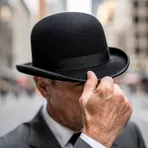
A hard round felt hat with a narrow brim that men wear
 8
6.7
8
6.7
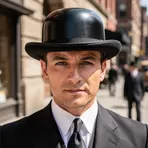
A hard round hat with a narrow brim worn by men
 1
6.3
1
6.3
A hard felt hat with a rounded crown and a narrow brim often worn by men
How Formal

Surface Forms
Morphology
The meaning is directly compositional: 'bowler' denotes a specific style of stiff, rounded-crown headwear and 'hat' is the general head covering, so together they simply name that style of hat. A B1 learner who knows both constituent words can therefore infer the MWE denotes a particular kind of hat.
Etymology
Bowler hat was first made by hat-makers named Bowler as a hard, low hat to protect workers' heads from low branches while riding. Because it was practical and soon worn by many city men, the hat came to be seen as a mark of a 'respectable' or formal style.