

to bombard
 13
5.4
13
5.4

- verb
- /bɑmˈbɑrd/
- The German Luftwaffe relentlessly bombards downtown London, while Churchill's Royal Air Force is in a deadly struggle to maintain control of the British skies.
Loading YouTube…
Watch on YouTubeMy hometown, my schools were all bombarded and destroyed.
- My hometown, my schools were all bombarded and destroyed.
- So Madrid was going to be bombarded by the Franco forces.
- Then Bismarck came with troops from Germany, bombarded the city, shelled it.
- So American forces were bombarding these islands.
- I think, you know, as we get into the final straight, they are going to be bombarded by those big guns.
- Just the asteroids bombarding and then Ed credits.
- There is not one moment in which a city isn't being bombarded.
- Some of them have billions of people on the world and they have ships that can, you know, bombard planets.
- And then we will all the coalition gathered up ready to go in and they bombarded the area for for about a month prior to it.
Examples
-
On April 6, 1941, German air forces bombarded the capital Belgrade and initiated a war against the Kingdom of Yugoslavia.
Academic text (2015) -
The Germans were bombarded day and night by British artillery and aircraft.
Fiction book (1996) -
The four US ships then began to bombard Peel Island as the US aircraft arrived.
-
I think, you know, as we get into the final straight, they are going to be bombarded by those big guns.
-
So American forces were bombarding these islands.
-
Napoleon soon arrives and positions guns to bombard the Austrians on the far bank.
-
In early August, Ottoman artillery began to bombard the fortress walls.
-
The soldiers used heavy artillery to bombard the enemy's fortifications throughout the night.
-
During the conflict, planes continuously bombarded the target area with precision strikes.
-
The protesters were bombarded with questions from reporters as they marched through the city.
Synonyms
 300
3.1
300
3.1
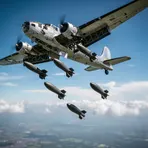
To attack a place by dropping explosive devices from planes
 27
7.9
27
7.9
To fire metal containers filled with explosives at a place or people to cause damage
 20
5.5
20
5.5
To hit something with many small things or to ask someone many quick questions
 19
7.7
19
7.7
To hit someone or something very hard many times
 8
7.3
8
7.3
To attack a place by throwing a bomb that starts fires
 1
7.4
1
7.4
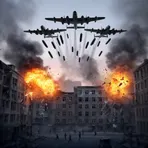
To attack a place suddenly and heavily, often by bombing from planes


 1
9.9
1
9.9
To attack a place with heavy guns like cannons for some time
To fire a quick series of shots at someone or something
Antonyms

Phrasal Verbs


How Intense

Surface Forms
Morphology
bombard = bomb (semi-transparent) = bomb + ard
The verb appears related to 'bomb' so learners can infer a meaning of attacking with explosive/projectile force, but the '-ard' element is a borrowed/less productive ending and the exact formation is historically from French rather than a regular English suffix.
Etymology
Bombard comes from the name of an old heavy weapon, like a cannon, and from the idea of a loud bomb or 'boom'. So to bombard someone originally meant to attack them again and again, which is why we use it for repeated throwing or shooting today.