
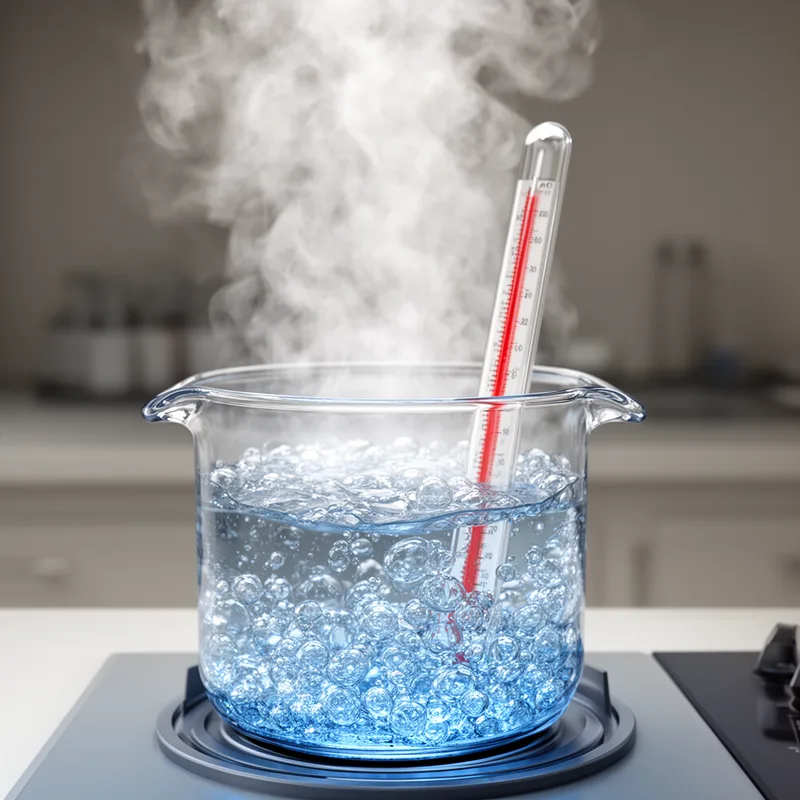
boiling point
 4
3.4
4
3.4

- noun
- /ˈbɔɪlɪŋ pɔɪnt/
- Specialized
- The boiling point of water at sea level is 100 degrees Celsius.
- boiling point of water
- temperature below the boiling point
- just below the boiling point
Loading YouTube…
Watch on YouTubeLet's take a concrete example of where we have a nice physical explanation, the boiling point of water, right?
- Let's take a concrete example of where we have a nice physical explanation, the boiling point of water, right?
Examples
-
One good indicator of a refrigerant's capacity is its normal boiling point.
Academic text (1998) -
The higher the boiling point, the lower the fluid's volumetric cooling capacity will be.
Academic text (1998) -
So now the boiling point is a function of pressure.
-
So at a given pressure, we're going to have a given boiling point, given temperature for water.
-
What is the boiling point of milk?
-
Could I raise the boiling point by applying more pressure?
-
And at higher pressures, of course, the boiling point goes up, not down.
Fiction book (2002) -
Change the density or the pressure, and the boiling point changes.
Blog text (30) -
The water still can get no hotter than the boiling point, whatever it might then be.
Blog text (30) -
Before the temperature of any portion of the meat can exceed the boiling point, all the water in that portion has to boil away first.
Academic text (1999)
Antonyms

- Specialized
1
2.8
The temperature at which a liquid becomes solid at normal air pressure
How Hot
- Specialized
4
3.4
 9
2.8
36
1.0
∞
1.0
9
2.8
36
1.0
∞
1.0
- Specialized
1
2.8
Surface Forms
Morphology
The phrase combines 'boiling' (intense seething or agitation) with 'point' (a specific stage or moment), so the meaning 'the moment when anger or stress becomes extreme' is a direct, metaphorical extension of the literal composition. The anger-as-boiling metaphor and adjective+noun composition are common cross-linguistically and follow standard English patterns, so a B1 learner who knows the constituents can usually infer the meaning.
Etymology
Boiling point comes from the image of a liquid boiling, making bubbles and steam at a certain point of heat when it 'changes to a gas', so the phrase names that exact temperature.