
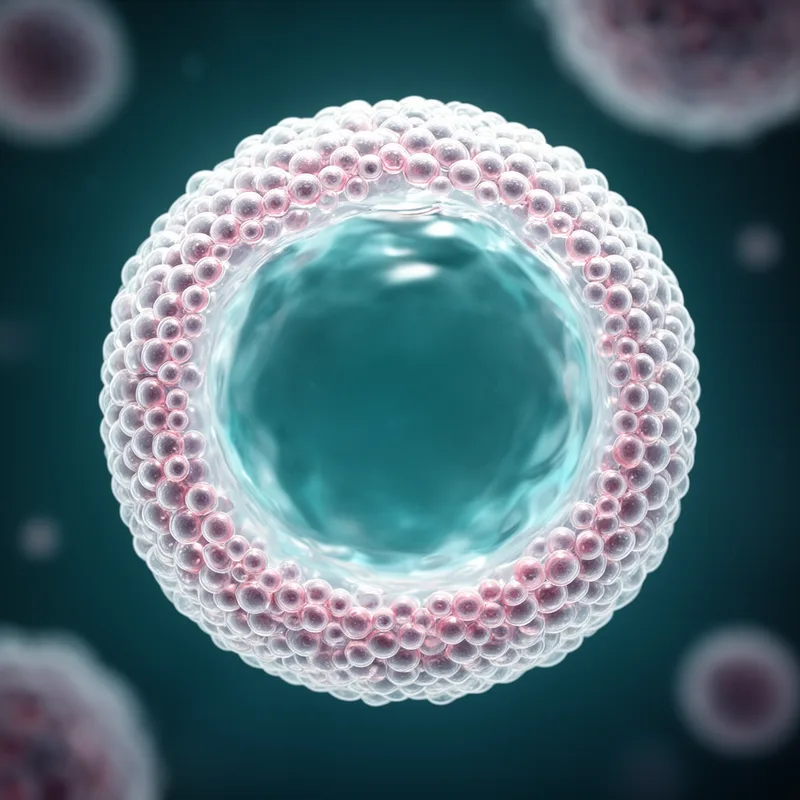
blastula
- noun
- /ˈblæstjʊlə/
- Specialized
- A blastula is formed shortly after the fertilized egg begins to divide into smaller cells.
- totipotency of blastula
- blastula nucleus
- blastula cells
Examples
-
Adult leopard frogs (A) are mated in the laboratory, and the resultant fertilized eggs (B) are permitted to develop to the blastula stage (C), with approximately 3,000 cells.
Academic text (1999) -
A blastula was a tiny globe of undifferentiated, multiplying cells.
Fiction book (1993) -
So this would be the sort of stage right before the blastula, before differentiation.
-
The blastula is dissociated to yield single cells (D) that will be used as nuclear donors.
Academic text (1999) -
To this end, they produced nucleocytoplasmic hybrids by transplanting a blastula nucleus of one species into an enucleated oocyte from a different species.
Academic text (1999) -
In their classic paper reporting the outcome of the experiment, Briggs and King (1952) showed that tadpoles developed from some enucleated eggs injected singly with blastula nuclei.
Academic text (1999) -
In the early development of a frog, the blastula stage precedes the formation of distinct tissue types.
-
The blastula represents a critical phase in embryonic development where the structure is still a hollow sphere.
Synonyms
A very early embryo formed as a hollow ball of cells with fluid inside before it attaches to the uterus

An early stage of a mammal embryo when some cells start to become different
How Developed


Surface Forms
Morphology
blastula = blast + ula
The term is built from a technical combining form 'blast-' and the diminutive/structural suffix '-ula', which is not a productive, familiar word for average learners, so the meaning is not derivable from common English vocabulary.
Etymology
The word blastula comes from the Greek root blastos meaning 'bud' and the small ending -ula meaning 'little', so it literally means 'little bud'. A helpful image is a tiny, hollow ball of cells like a little bud or bubble, which is an early stage of an embryo.