

to black out the memory
- phrasal verb
- /blæk aʊt ðə ˈmɛməri/
- Some people black out the memory of traumatic events as a coping mechanism.
Examples
-
He found it nearly impossible to black out the memory of his childhood hardships.
-
After the accident, she tried to black out the memory of what had happened.
-
She tried to black out the memory of the accident.
-
I want to black out the memory of that painful breakup.
-
After the trauma, she knew she needed to black out the memory of that day to move on.
-
To cope with the pain, he decided to black out the memory of his past mistakes.
-
Many individuals black out the memory of their grief to protect themselves from emotional pain.
Synonyms

 ∞
1.8
∞
1.8

Decide not to think about something
 75
6.6
75
6.6
Keep strong feelings or memories from coming into the mind
 8
5.4
8
5.4
Hide something so you cannot see it or remember it


 1
9.9
1
9.9
Choose not to remember something painful
Antonyms

How Accessible

Surface Forms
Morphology
The compound 'black out' combines 'black' (to darken) with the particle 'out' suggesting removal or exclusion, so a learner could infer a metaphorical sense of making a memory disappear. However, the idiomatic extension to intentionally suppress or block recollection is somewhat metaphorical and context-dependent (the verb has multiple senses like power failure or fainting), so the exact meaning is not fully predictable without exposure.
Etymology
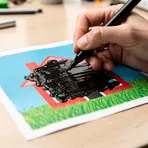
Black out the memory comes from the simple image of covering a picture or text with black paint or a marker so you cannot see it. So to black out a memory is to hide it in your mind—trying to 'forget' or 'avoid remembering' something painful.