
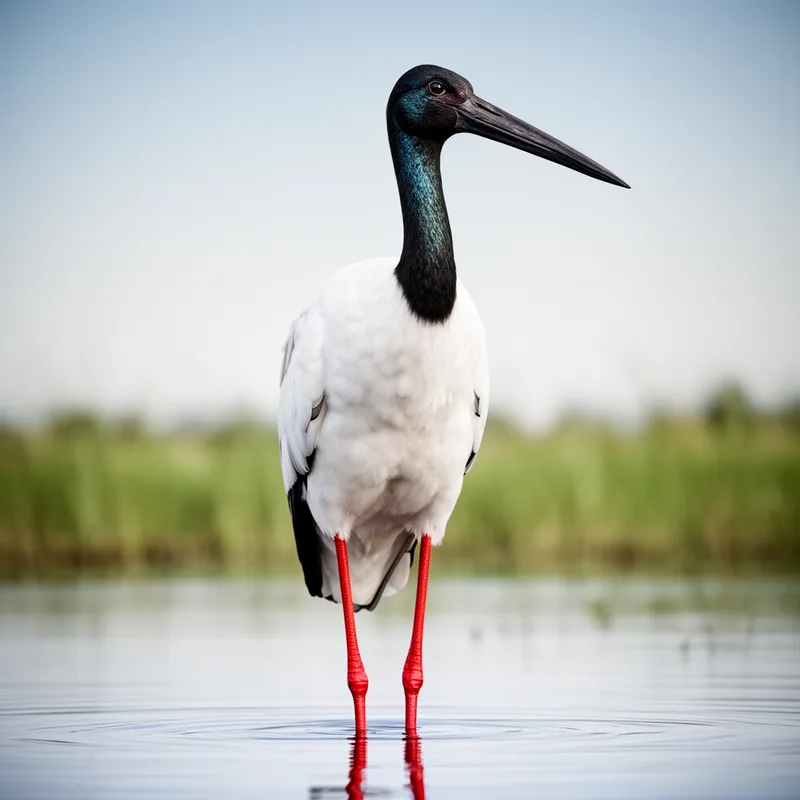
black-necked stork
- noun
- Australian
- The black-necked stork is most commonly seen in wetlands across northern Australia.
Examples
-
Unlike other storks, the black-necked stork has a striking iridescent neck and long red legs.
-
Birdwatchers were excited to spot a black-necked stork near the riverbank during their trip.
-
The black-necked stork is a magnificent bird.
-
Have you ever seen a black-necked stork?
-
Birdwatchers were excited to spot a black-necked stork near the riverbank during their trip.
-
The black-necked stork is most commonly seen in wetlands across northern Australia.
-
Unlike other storks, the black-necked stork has a striking iridescent neck and long red legs.
Synonyms
A large white stork with a black neck found in Australia and parts of Asia

A large mostly white stork with a black neck that lives in Australian wetlands
Surface Forms
Morphology
black-necked + stork
The phrase is a straightforward descriptive compound: 'black-necked' signals 'having a black neck' modifying 'stork', so the overall meaning 'a stork with a black neck' is directly derivable from the parts. This color + body-part + adjective pattern is morphologically regular and cross-linguistically common, so a B1 learner who knows 'black', 'neck' (and 'stork') will understand it.
Etymology
Black-necked stork gets its name from how it looks: the bird has a white body and a shiny black neck and head. Because that dark neck is the bird's most obvious feature, people used it as the name, so the phrase simply means this bird.

